
Meet Mick Holloway, our resident expert on all things Randolph County. This lifelong resident of Randolph County is a veritable fount of knowledge with an incredible talent for storytelling, an amazing sense of humor, and a wit to match. You can usually find Mick in the back room at the museum searching through old newspapers for stories to add to his personal collection or doing research for a member of the Society. Mick will be the official blogger for the Society, sharing tales of old.
Monday, October 14, 2019
156. Admitted To The James Moorman Orphan's Home- Garringer, Chloe Irene.
This is the standard admittance form used at the Moorman Orphan's Home;
CHILD
Name Chloe Irene Garringer
Sex Female
Color White
Color of eyes Blue
Color of hair Brown
Date of birth Aug. 5 1923
Place of birth Winchester, Ind.
Contagious diseases child has had:
Before entering home Measles, Mumps, Pink eye, Chicken pox, Itch, Scarlet Fever, Trench Mouth
Date admitted to home Nov. 7 1939
By whom placed in Home Orphans Home Board
If child is not normal, mentally or physically, state defects Overweight 264 1/2 pounds
Property belonging to child None
Transferred from what school corporation Winchester
Has proper transfer for school purposes been made Yes
FATHER
Name Orville Jasper Garringer
Address Winchester, Ind.
If deceased, cause of death,
MOTHER
Name Helen Arletta Garringer
Maiden name Nash
Address Portland, Ind. R.R. 1
If deceased, cause of death,
Are Parents living together?
Are parents divorced?
If divorced, has either married again?
BROTHERS
Lewis James,
Lloyd Keith
Dean Clinton,
Ivan Duane,
Ronald Wayne, at orphanage
Max Robert, at orphanage
SISTERS
Norma Louise, at orphanage
Elsie Merle, at orphanage
If any are deceased, cause of death,
Paternal Grandparents Mr. & Mrs. Eugene Garringer, Portland, R.R. 1
Maternal Grandparents Mr. & Mrs. Harry Nash, deceased
Placement of child with whom Released to parents (on the brother's and sister's forms it is noted that they were also released to their parents.)
Mrs. E. Estella Moore Orphanage Matron

Sunday, October 13, 2019
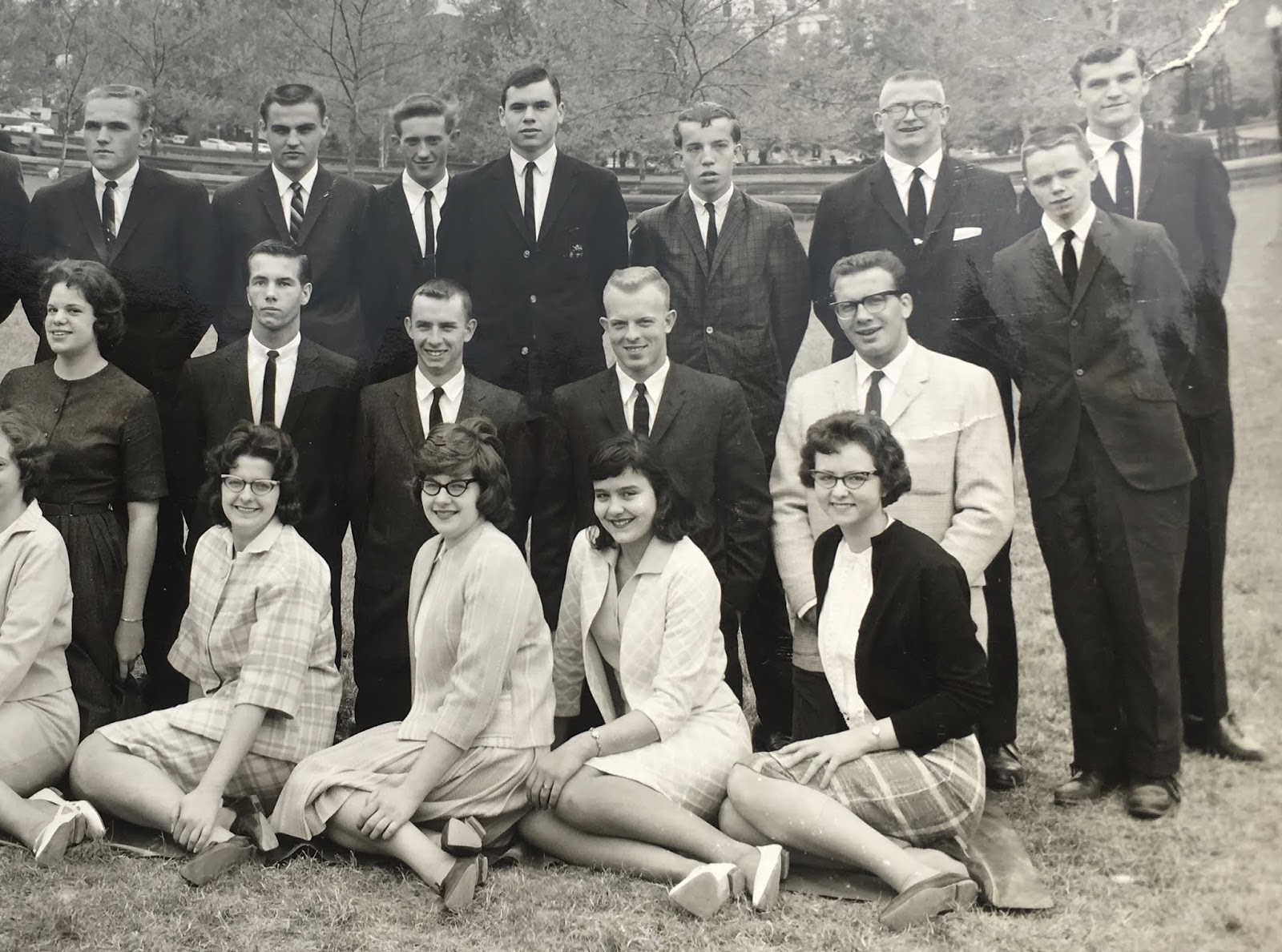
155. Driver High School Class Visits Washington DC, 1963
Driver High School - Class of 1963
Washington D. C. in April 1963


If you can identify someone, comment below and the blog post will be updated.
 |
| Left side of photo. |
 |
| Center-left of photo. |
 |
| Center-right of photo. |
 |
| Right side of photo. |
 |
| Top right of photo. |
 |
| Top center of photo. |
 |
| Annual for Driver High School 1963 available for review at RCHS County History Library. |
Monday, October 7, 2019
154. Randolph County Misc.
1961. Randolph County Has More TV's Than Bathtubs.
It now has been statistically established thet residents of Randolph County have more television sets than bathtubs.
This may begin the decline of the proud claim that Americans prefer cleanliness to everything else.
The occasional citizen may jeer at the "boob-tube" and "idiot-box" but a short look at the figures will show that regardless of his words, the American in these parts prefers his home screen entertainment to bathtubs or showers. The margin is narrow, but the fact is plain.
This somewhat surprising statistic is one of a group concerning Randolph county households just released by the U.S. Department of Commerce following it's housing census.
In scanning these figures for items which contribute to better living, you are promptly impressed with the total triumph of television over all other things except flush toilets of which occupied housing units have 302 more than TV sets and automobiles which win by one more car owning household than units with televisions.
There are 116 more living units with television than with radio and 689 more with television than with telephones.
The survey finds that there are 9,752 dwelling units in the county, of which 9,082 are occupied. This leaves 670 unoccupied units. Of the occupied living units, to look at the negative side, 690 have no hot and cold running water, 702 have no flush toilets, 1,000 have no television and 999 have no automobiles.
On the luxury side, however, of the 9,082 occupied units, 6,122 own one auto per unit, 1816 own two and 145 tycoons are the owners of three or more cars per housing unit. Of the total of 9,752, 7,057 living units were found in sound condition with all plumbing, and 460 are enjoying the hot weather luxury of air conditioning.
Basements, once a must for every home, have declined in popularity, figures show. Of the total housing units, only 4,761 had basements.
The Department of Commerce census takers found 187 families in Randolph county living in trailer homes.
Home appliances to aid the housewife were found to be fairly numerous in the county, but the 7,541 units with washing machines were still far behind those with televisions. Of the total, 2,917 homes have clothes dryers, and a large number, 3,492, had one or more home freezers.
Randolph county residents tend to be homeowners, as the statistics reveal, with 6,457 units occupied by owners and only 2,625 by renters. But rentals locally are not high, $64 per month being the median gross rent. Nor is the median value of properties high, the average being $7,800.
The overall pivture, quickly scanned, appears to be that of a people who slightly prefer home entertainment to baths, who somewhat prefer the comfort of indoor toilets to entertainment, and just barely put transportation ahead of the evening TV show. It appears to indicate that Randolph county residents are a fairly solid lot who like to be homeowners and, with rare exception, live on a modest scale, both as owners and renters, with a good number of housewives doing their own washings and many thrifty wives making use of the deep-freeze.
It would have been convenient if the Department of Commerce had gathered figures while it was at it, on the several trends, both local and national. For instance, how many homes own barbecue grills? How many power, as opposed to hand powered, lawnmowers are there? Are there more speedboats than there are two car families? But no matter how many statistics are available, it is quite apparent that the forest of television aerials is the new skyline of the United States, including Randolph county. The only question remaining is, what do those unfortunates living in the 1,000 homes with no television do in their spare time? Winchester Journal-Herald, by Anna Marie Gibbons.
______
1963. Early McKinley School.
A unique occasion will be observed on Saturday evening when the alumni of the old McKinley school holds their annual banquet.
Scheduled for their fiftieth reunion will be the class of 1913, which is the first graduating class from a rural consolidated school in Randolph county and possibly the first from a rural consolidated school ever graduated in Indiana.
Moreover, every single member of McKinley's class of 1913 is living and healthy and plans to be present at the reunion. Of course, the total class membership was only three to begin with, but all three are still very much in evidence.
Members are David KABEL, Ethel MANN BALDWIN and Florence BECK, all in their late 60's.
Possibly the rigors of getting to high school in the first place developed strong constitutions in the class of 1913. Two members walked at least a mile and a half daily to get to school; one Mrs. Baldwin, walked a total of three miles daily. "We really wanted an education in those days," Mrs. Baldwin recalls. "We were willing to walk a long way to get it."
Mrs. Baldwin should know. In order to get to McKinley to complete her high school training she walked daily from the family farm four miles northwest of Winchester, to the east-west Interurban line, where she took the car east through Winchester. Getting off at White River station she then walked a mile to McKinley. Florence Beck, who lived a mile and a half south of Lincoln school and four miles west of Winchester, drove a buggy two miles to the Interurban line but the mile from White River crossing was covered on foot.
Kabel, the tycoon of the trio, rode a bicycle when it was possible, and otherwise drove a buggy from the family farm a mile south of Winchester. As a break for gaining points with the faculty, he had as passengers in the buggy two teachers, Bessie STEVENSON and Minnie MERCHANT.
Lincoln was the first rural consolidated school built in Randolph county, under a program sparked by the late Lee Driver, a program which became nationally, and even internationally, famous as a model for rural school consolidation at the time.
However, Lincoln, built in 1908-09 did not graduate a senior class in 1913. Two of the 1913 class, Florence Beck and Ethel Mann, came from Lincoln on transfer to McKinley. Kabel first attended Winchester high school, then McKinley. (Until the rural consolidated high schools were complete, any county student within the area who wanted a high school education had to attend Winchester high school. Some boarded temporarily in town to do so.)
Once at the new school, the students did not find any fewer rigors, or so it might seem to a modern-day student. Until McKinley was completed, the three classmates, who entered after two years in high school in their other schools, attended classes in the barn. "It was like a one-room," they recall. Was it cold in winter? Why, no. They had a stove and it was quite comfortable. McKinley was completed in December, 1911, they recall after which the class of 1913 moved from the barn to the new building.
Although there will be other reunion classes at the McKinley alumni banquet, the class of 1913 will hold the place of honor. Florence Beck, who maintains a home in Winchester and is now engaged in sales work, also taught after high school graduation in one of the remaining county one-room schools, a tradition carried on by her nephew, the present Randolph-Central superintendent, Merritt BECK.
She then attended Madam BLAKER's school at Indianapolis for a year's training, returning here to serve as Lincoln first grade teacher for four years.
Ethel Mann Baldwin also taught in a one room school in White River township after graduation. Mrs. Baldwin is married to Russell R. Baldwin, and now lives four miles southeast of Winchester on the Greenville Road. Mrs. Baldwin is the only one of the class who has graduates of her own-her youngest son, Russell, is a Lincoln graduate. Another son, George jr., is a 25 year alumnus of McKinley. Two other children Louise Baldwin BARTLETT and Warren Baldwin are graduates of Green township high school.
Kabel, who now lives in Winchester is a retired farm implement dealer.
The 1913 graduates are not inveterate alumni banquet attendees, but feel that this is an occasion on which they must be present. They plan to reminisce about school days and brief younger alumni on how things were 50 years ago at the new McKinley school. With McKinley closed after the new White River school was built and the Winchester-White River merger, the 1913 trio form the first class of a limited group. It is bracketed by the lifetime of McKinley high school, first rural consolidated school to graduate a class, one of the first rural schools in the county to merge with other schools in the new, still incomplete school building and reorganization program aimed at again bringing this county up-to-date in the expanding school program of the state.
Randolph County Enterprise, May 16, 1963.
______
1927. Carlos Church Quilt Sells.
The entertainment at the school building, Friday evening, was enjoyed by a crowded house. The Liberty orchestra furnished excellent music. Dora Francis CONWELL. Ina Mae MURRAY, Miss Naomi COX, Miss Marion WHITEHEAD and Miss Ruth NEWMAN gave readings and Misses Idona COX and Mary SWINDELL, and Ina MAE and Catherine MURRAY sang duets and Miss Esther OREN sang two beautiful solos accompanied at the piano by Miss Helen WHITEHEAD. Rev. N.H. THORNBURG, of Farmland, the pastor, gave a talk on the home, school and the church, after which the quilt sold at auction to Clyde CATEY for $76. Mr. Frank METZ of Winchester, who had given ten dollars to have his name in the center block, bid seventy-five dollars. Over sixty dollars had been realized for the names of church members and area folks that were sewn onto the quilt, making of over $135 which will be used for the church which is to be erected this summer. Home-made candy and pop-corn sold amounted to about eleven dollars. Those attending from a distance were Mr. and Mrs. Troy PUCKETT and W.F. Metz of Winchester; Mr. and Mrs. Carl MOORE, of Fountain City; Mr. and Mrs. Orville Miller and son Irvin, Mr. and Mrs. Earl ADAMSON and daughter, Frances, of Hagerstown; and Mr. and Mrs. Ray VANDERBURG, of Seattle, Washington.
______
1962. Founders Day Preparation.
Winchester will celebrate Founders Day July 17 through July 22. That much is an established fact. How well the program is carried out and how beneficial it is to us as a community and as individuals, depends on us.
There can be many advantages to the Founders Day celebration. It promises to be profitable financially, and if it is, the profits will be used for community betterment. It should stimulate local business.
And it should give us all a more vivid impression of our beginnings as a city, and civic growth and change. Perhaps most significant of all, it will offer the best opportunity the community has ever had to work together for a successful enterprise of benefit to everyone.
The committees, non-partisan, have the ball rolling; experienced professional help has been brought in to help guarantee success.
Founders Day will be more than a street-fair, it will be a dramatization of history, but with plenty of fun on the side. The more people that pitch in and help, the bigger and better it will be, and the more fun.
So let's get together, and really CELEBRATE!
March 12. A $75 prize will be awarded to the man with the best beard at the Founders Day celebration in July.
The announcement was made today by Bill BERTRAM, chairman of the celebration, who added that the barber's union will appoint a committee to judge beards.
Barbers will also offer a long discontinued service, beard trimming and styling before the celebration. Men who have always had a secret yen to ornament their faces with whiskers can come into their own in the weeks leading up to the Founders Day week, the barbers point out.
Further, those who plan to raise a crop of facial oenament are urged to begin soon, so that they will have ample time to work out the most becoming growth. It is the hope of the committee that weird beards, bushy beards and handsome beards will be among the varieties displayed.
Also up for a $75 prize will be ladies costumes, the most appropriate historically, to be the winner. These costumes will be judged by a panel from women's dress shops it is understood.
May 26. Winchester women have taken up the challenge offered by their menfolk and are preparing to spend Founders Day week in special costumes of their own. In answer to the men's fancy mustaches and beards, women of the community will appear in bonnets and gowns reminiscent of the pioneer women who first came to this area.
Although their dainty gingham checks, sprigged cotton and frilled bonnets may be a bit fancier than those worn by their ancestors in these parts, women who have tried on the costumes look believably 19th century.
Mrs. Helen MILLS, chairman of the women's costume committee, reports that there will be mother-and-daughter costumes available in matching colors, too. The dresses are made to be worn with hoops if preferred, although certainly pioneer women of Randolph county had to set aside their hoops for the hard farm work that filled their days.
However, since Founders Day may be considered a state occasion, even the backwoods mothers would probably hunt up a set of hoops to wear with their Sunday homespun.
Official title of the costumed ladies will be "Jubilee Belles," and each woman who buys a costume will be given a badge and certificate.
June 14. The first session of Kangaroo Court in connection with the July Founders Day celebration will be held on the court house square.
Men of the community are urged to wear their Founders Day hats, ties and Brothers of the Brush badges and attend the court.
A vigilante committee will round up offenders and Bob HEASTON, as "Badlands Bean" will mete out justice.
Later Friday evening, a street dance including both round and square dancing, will be held in the downtown area, beginning at 9 p.m. Live music will be featured.
On Saturday morning, a special ceremony to "bury the razor" will be held in downtown Winchester, during which the Brothers of the Brush will hold an old-fashioned funeral complete with band and mourners. Heaston reported "After Saturday, he warned, "all smoothies" will be fair game.
h
Thursday, October 3, 2019
153. Early News Of A 1962 Winchester Founders Day Celebration.
March 1, 1962. Committee Chairmen Are Appointed For City Founders Day Celebration.
While most of the nation was busy projecting its imagination into a future space-age interplanetary voyages, a group of Winchester citizens met to plan a return to the dress, fun and customs of the early 19th century.
The meeting was called by Bill BERTRAM, general chairman of Winchester's Founders Day committee, which began plans for a celebration to be held this summer commemorating the 15th decade since the city's founding.
The meeting was organizational, with committee chairmen appointed to handle various details of the six-day celebration, designed to be the first of a series, which, its originators hope, will be held each year until the date for a sesquicentennial celebration. Forty-five persons attended the meeting.
Dates are July 17 through July 22.
Chairmen appointed were Gerald PRESCOTT, in charge of the Tuesday evening historical parade; Mrs. Don DALY, Monday evening show chairman; Raymond TANNER and Mayor Ralph WEST, co- chairmen of the Wednesday evening torch-light parade, rally and ox roast; Glen HODSON and the barbers union, chairmen for beard-judging and awards; Jack ZALTSBERG, chairman of sidewalk merchandising; Dick CAMPOS, music chairman; Jerry HERRELL, pageant director; Joe Hamilton and Wallace FIELDS, pageant script; John HAINES, Mrs. Joe DRISCOLL and Miss Edith HALE, Jaycee and sorority chairmen for the grand ball; Randall BOWMER, chairman of a horseshoe tournament; G.J. CONLEY, Charles McROSE and the Winchester Kiwanis Club, finance committee.
Considerable discussion was held concerning concession booths to be set up around the public square during Founders Day celebration. It was agreed that booth holders, which can be any county organization from Cub Scouts to home demonstration clubs, must pay a flat fee of $25 for space, plus 10 per cent of gross profits; each booth must arrange for its own electrical connection, but electricity will be provided. Booth space will go on sale March 5. G.J. Conley will be in charge of the booth-chart.
Mrs. Helen Mills, local beauty operator, was present at the meeting to offer to style women's hair in the proper 19th century manner for the ball and pageants.
Bertram said that the profits from booths and other possible concessions will be used to help finance the general celebration.
April 26, 1962. Producing Company Hired.
A producing company has been hired at a cost of $6,650 to organize the Winchester Founders Day Celebration, July 14-21.
The producing company has organized hundreds of such historical events. The firm will aid in the organization of committees and committee work. It will write the historical pageant and furnish a business manager-director of six weeks as well as furnishing 275 costumes, a stage backdrop, lighting, make-up for the cast, properties, etc.
Besides the physical things, the firm will be offering its experience and know-how and time of its employees. No one in Randolph county has the time or experience to produce such an affair.
The project can be a benefit if we do more than reflect for a week on the tremendous debt we owe to the persons who founded this community.
Then there is a real challenge to make this a successful affair as the profits will go into a fund to develop new industry, so vital to the growth of this area.
This is a project that hundreds of persons, in fact every member of the community, can take part in and enjoy.
Don't wait for someone to contact you to help....offer your services now to the officers of the non-profit company which will put on the celebration.
Surely we can each accept this challenge which is so small in comparison with the one faced by the men and women we intend to honor July 14-21.
May 8, 1962. A PROCLAMATION
WHEREAS; The year 1962 has been dedicated to celebrating the One Hundred Forty-Fourth year of Winchester's incorporation, and,
WHEREAS; The great Village of Winchester has set aside the dates July 13 through 21 of this year to celebrate this important milestone with Parades, Praise and Pageantry, The Great Winchester Spectacular, and, to remind us of the customs of our male citizens in early days
WHEREAS; The male citizens of this village are desirous of entering the spirit of this historic event by wearing hair on their face where heretofore it has not appeared to remind us of the customs of our male citizens in early times,
BE IT HEREBY RESOLVED; That I, Ralph M. West, Sr., Mayor of Winchester, Indiana, hereby proclaim that these public spirited citizens shall become members of the great fraternity known henceforth as "BROTHERS OF THE BRUSH."
Members in good standing will agree to raise facial adornments in the form of mustaches, sideburns, goatees, full beards, or any combination thereof from this date forward until July 21, 1962. Members in good standing shall participate in such activities as directed to publicize our Great Winchester Founders Day Celebration; by joining chapters of the "Brothers." by participating in booster caravans and by wearing official derbies, top hats and/or similar old fashioned apparel before and during the actual celebration days.
This Proclamation issued in the Founders Day spirit of good fun, and in recognition of the importance of visual support by all male citizenry of our glorious Founders Day Celebration.
Proclamation signed this May day of 1962 by hand and seal. Mayor Ralph West, Winchester, Indiana.
May 10, 1962. Celebration Resolution.
WHEREAS, there has been formed a citizens committee to carry out plans for celebrating this Founders Day event, and
Whereas, it is the desire of us all that this event be a self sustaining event financially,
BE IT HEREBY KNOWN, that the Celebration Committee anticipates revenue from such projects as admissions to an historical pageant spectacle, and historical program advertising booklet, a carnival and the sale of such novelties and souvenirs as Booster Badges, Membership Certificates, Wooden Nickels, Commemorative Coins, Old Fashioned Wearing Apparel plus Ties, Plates and similar items,
BE IT HEREBY RESOLVED THAT NO INDIVIDUAL, COMPANY OR ORGANIZATION will sell, trade or give away anything that has a celebration reference or connotation without first obtaining written permission from the Founders Day Committee. APPROVED by City Councilmen: Ralph Drill, Fred Pittenger, Earl Junior Byrum, Ulysses Hinty, Mike Make and Mayor Ralph West.
If I can sweet-talk Thursa into posting some pictures, I'll have more later on Founders Day. mh
Monday, September 30, 2019
152. September 25, 1965 Newspaper
The Winchester Journal-Herald newspaper
September 25, 1965


Homecoming 1965.
The second annual Homecoming at the Driver High School is scheduled for October 1, 2. The theme for this year is "From The Land Of Mother Goose" with class floats being created around this theme. Work has already started on many floats.
The Homecoming parade is scheduled for Saturday night, at 6:30 p.m. with the Homecoming game against the Cambridge City Eagles at 7:30.
Homecoming queen candidates are Marsha Wickersham representing the sophomore class; Kathi Sutter, senior class; Carol Breaker, junior class; and Susie Fast, freshman class. Miss Breaker recently moved to the Winchester community from Anderson.
Last year was the first year for the local high school to have a Homecoming celebration. Miss Anne Overman, daughter of Mr. and Mrs. Don Overman, who was a member of the 1964 senior class, was chosen as the first Homecoming queen.
______
m
Friday, September 27, 2019
151.Randolph County Misc. (Jaycee Mardi Gras, Fudge Mound, Townsandville, Bootleg Liquor, Modoc, Church Burns, Bronson, Losantville)
RCHS Blog Post Number 151.
Randolph County Misc.
(Jaycee Mardi Gras, Fudge Mound, Townsandville, Bootleg Liquor, Modoc, Church Burns, Bronson, Losantville)
_________
Jaycee Mardi Gras
Winchester Journal-Herald. October 17, 1960.
 |
| Date of photo not noted on the poster that was donated to RCHS. |
Downtown Winchester was jammed with holiday crowds Saturday afternoon and evening during the annual Jaycee Mardi Gras festivities. Thousands of people lined the streets to watch the parade of queen candidates, high school bands, masqueraders, National Guardsmen, Boy and Girl Scouts, antique automobiles and riders from the Circle-X.
A crowd estimated as high as ten thousand people massed around the public square during the evening's entertainment. They saw Miss Donna BOWEN, Spartanburg high school senior, crowned Queen of the Mardi Gras, with Miss Joy PEACOCK of Farmland and Miss Mary Ann HIATT of Ward-Jackson as attendants. Miss Bowen had also been chosen as "Miss Personality" by the queen-candidates.
The Jaycees luck held when an early threat of rain failed to materialize. Pleasant, warm weather was probably one factor which encouraged the large attendance at the festival, with larger crowds in both afternoon and evening than there have been for a number of years. The Jaycees' share of booth, concession and carnival returns was expected to be high due to the attendance at the Mardi Gras.
Glen PETERS, Jaycee treasurer, reported donations of $425, which lighted seventeen candles at the candle-light ceremony Saturday night. Although the Jaycees had hoped for twenty-five candles, which would have meant pledges of $625 for their Exceptional Children's fund, Peters said he was confident that booth receipts, of which the organization will be 25 per cent would add enough to bring in sufficient funds for the Jaycee project.
______
Prehistoric "Fudge Mound"
Winchester Journal-Herald. October 3, 1929
The work of excavating the prehistoric mound in what was once the fair grounds at Winchester has just been completed. The work was done under the direction of Frank SETZLER of the University of Chicago promoted by the Indiana Historical Society and the Smithsonian Institution of Washington, D.C.
Early settlers here discovered these prehistoric works which included an earth embankment in the form of a parallelogram enclosing about thirty-one acres with entrances on two sides and the mound at about the center of the enclosure. The embankment was several feet high in early days but only traces are seen today.
Mr. Setzler and his helpers began the work of excavation several weeks ago. A careful survey was the first made of the mound to determine its height and diameter. It was staked off in five foot sections and the work of digging began on the south side, a section being excavated at a time. Great care was necessary in removing the earth to see that nothing valuable was destroyed.
The survey showed the mound to be about seven feet high and eighty-five feet in diameter. Early settlers remember it as being quite a bit higher and not so far across, time having flattened it out.
The diggers soon struck the floor or sod line of the mound and advanced the excavation on that level, section by section. photographing each section as it was completed.
The results of the excavation from an archeological view point, as furnished for the Journal-Herald by Mr. Setzler, are as follows: The entire mound was built for the purpose of burying a middle-aged person, who was evidently a person of note. At about the center of the mound there was found evidence of a burial. A pit 5 by 8 feet and 3 feet deep had been dug. Much red ocher was found here and in other places in the mound. In this pit was found the only skeleton discovered in the mound. With this skeleton was found the skull of a young person but it was badly broken. This skull lay near the hips of the skeleton. In all probability this skull was buried for ceremonial purposes.
Part of the body was found a series of post holes about 6 inches in diameter showing that there had been at one time, a wooden structure enclosing the body found. About two feet from the periphery of the pit was found a row of small stake holes one inch in diameter, there being as many as 24 in 10 feet. Also 3 feet beyond this row of holes was found another row of holes 3 inches in diameter and 14 holes in 10 feet. These are also proof that a wooden structure had been built around the inner burial chamber. The form of these three enclosures conformed closely to the form of the large outer embankment enclosing the mound.
Around the burial pit and 3 feet higher than where the skeleton lay, and to the south and west, there was a heavy stratum of bark and ocher. In this stratum were found votive offerings to the dead. These consisted of two broken ceremonial spear points, one carved and drilled slate gorget and one sandstone gorget. A good deal of burnt clay and cremated animal bones was found. On the west side and opposite the burial pit were found two leather pouches surrounded with bark containing numerous copper bracelets. The leather was so decomposed that only parts remained, the form being retained by the copper rings. Sodium Silicate was immediately sprayed over them in an attempt to preserve their original form. They will not be opened until the material is studied in the laboratory in Indianapolis.
These pouches were found on a bed of burnt clay and cremated animal bones. This is the first time any copper bracelets have been found in a scientific excavation of mounds made in Indiana.
The findings in the mound are well worth the efforts put forth and adds some additional knowledge concerning the ancient peoples who inhabited this country we know not when.
Mr. Setzler wishes to express his gratitude to Messers FUDGE and MONKS for their kindly cooperation and to the many people who became interested in the work.
A further survey of the location of mounds in this section will probably be made next year.
_____
Townsandville
1880.
Townsandville, Randolph County, is 2 1/2 miles north and one mile east of Farmland.
______
By the invitation of Sheriff Lee BRINER, the W.T.C.U. (Women's Christian Temperance Union) met at the county jail last Friday afternoon where over 100 gallons of liquor, including white mule, wine, beer etc., was disposed of by being poured into the sewer. About 100 people from Union City, Huntsville, Green Twp., Spartanburg, Losantville and Winchester Unions were present and each member was given an opportunity of emptying some of the liquor into the drain. In the absence of the county prosecutor, Mrs. Mary BLY, of Huntsville, Mrs. Pearl BRAGG, president of the Winchester Union, presided. The meeting opened by signing Onward Christian Soldiers, which was followed by prayer given by Mrs. MARTIN, of Green Twp. Rev. Frederic CARTER then made a short talk after which the "grand pouring." After disposing of the liquor, the slot machines were destroyed and the money, $4.60, which was in the machine, was turned over to the treasury of the W.C.T.U. to assist in carrying on their work.
_____
West River Township was organized in 1819. At first it comprised all of the southeastern portion of Randolph county. Later Nettle Creek Township was formed, in 1835, from the west portion of West River so that the early history of this part of the county is connected with these two townships.
Some land entries were made as early as 1810 but the permanent settlements were made about 1816.
Hugh BOTKIN settled southeast of where Huntsville now is in 1816.
Many of the early settlers in this region were from Kentucky. They were a sturdy class of people and so impressed their moral and industrious character upon the community that it has remained a church going and industrious people ever since.
Various religious denominations have served the people throughout the history of this section of the county. Many of the first inhabitants were Methodists and circuit riders held religious services in the cabins of the pioneers.
The early settlers had their ups and downs as was common in the settlements of Indiana. House raisings, log rollings, quiltings, singing schools were among the opportunities which enabled the people to get together and become acquainted.
This region was visited in 1824 by a terrific tornado. Quite a strip of the virgin forest was leveled by the storm and formed what was known as the "Fallen Timbers" for many years. This strip of country grew up with briars and bushes and served as a hiding place for fugitive slaves. Slave hunters often visited the place in search of runaway slaves but the sturdy Abolitionists gave them a cold shoulder and no help in capturing their slaves.
Robbers and other criminals often sought to hide in the fallen timber region but it was kept pretty free from such characters.
The dense forests of this region served as a nesting place for the wild pigeons for a number of years and the "Pigeon Roost" was known far and wide.
Mills, blacksmith shops, wheelright shops, country stores and other pioneer industries came into existence soon after settlements began. Hugh Botkin established a tannery soon after settling and it existed for many years.
A socialistic experiment was tried in the Unionport settlement following the leadership of John O. WATTLES. A community woolen mill was built but it failed to prosper. The society did not flourish and the enterprise went to pieces, many of the members lost about all they had put into it.
A number of villages were started but all have gone the way of the world except Carlos City, Huntsville, Modoc and Unionport.
This region has become noted for its agriculture and stock raising.
Modoc, located about fifteen miles southwest of Winchester, is one of the small enterprising towns of Randolph county. It is said that the name, Modoc, was chosen in a unique manner. A group of men gathered in the general store of GADDIS and SHOEMAKER and were discussing names when someone noticed some bottles of Modoc Bitters on a shelf and suggested the name of Modoc, which was the one chosen by the postal authorities from the list submitted.
Thomas DOUGE built the first house and owned the first store in the small building where the Barker Harness Shop now stands.
Ira SWAIN was the first postmaster and while he held this position the post office was moved from Swain's Hill.
H.A. GADDIS and J.K. SHOEMAKER had a general store at Lee's Summit. This building, with its contents, was moved to the site of the present bank building. A good trade was kept up all along the route of moving.
The U.B. Church was here when the town was started. Some years later a new building was erected near the site of the old one. In 1888 the M.E. Church was moved from Concord to Modoc and a few years later a Nazarene Church was erected.
The first school, a three room frame structure, was built in 1890. The present one is of brick and was erected in 1910. The Bank building was constructed in 1911.
The first train ran over the I.B. and W. Railroad on June 1, 1882. The railroad station burned February 29, 1912, and was replaced by October of the same year.
_______
For Sale, A good outside toilet. Ed STAKEBAKE, 722 W. Washington st.
______
About half past two o'clock last Wednesday afternoon the fire alarm sounded and it was with little or no difficulty the site was discovered, as by the time the alarm was given huge volumes of smoke was issuing over South Meridian street from the west. The wind was blowing gales at that time and for that reason the alarm sounded more dreadful. In less than two hours the homes of J.S. HIATT, Charles SMITH, Mrs. Benjamin SIMMONS, Mrs. Merle FARQUHAR, Mr. RAU and the handsome M.E. Church and the barns of Mrs. William ASHTON, Charles SMITH, Mrs. Farquhar, J.S. Hiatt, Andy AKER and Frank BUNDY were complete ruins.
Several ideas are advanced as to the fire's origin, one being from boys shooting firecrackers, another from sparks from the heading factory on the west side of the railroad. The fire was first discovered in Mrs. Ashton's barn on an alley parallel on the west with Meridian street; the flames fanned by a furious gale soon spread to the other barns and to J.S. Hiatt's property, and as the Charles Smith and Mrs. Farquhar property were very close they too were soon in flames.
The high wind carried cinders of large size into the ventilator on top of the high roof of the Methodist Church and soon ignited it; the cinders were probably helped in their work of devastation by bird's nests in the ventilator. The dwelling of the late Mrs. Pheobe REED was unquestionably saved by the giant maple trees which stand in front of that lot. The house occupied by Mr. Rau on the south of Mrs. Farquhar's property, owned by Mrs. Cora VEACH, burned to the ground and the home of Mrs. HOUSER, just south of Mrs. Veach's property was extinguished by hard work after one end was burned. The property of Mrs. BOWEN, of Chicago, occupied by Joe HUFFMAN and Mrs. Pheobe Reed's barn were saved after hard fighting. The barn of B.F. Bundy, to the east of The church, was also consumed, but the high walls of the church doubtless broke the heavy winds and flying embers, many believing that if a frame building had stood where the church was, the wind would have made the fire sweep a path through the east part of town. Shortly before the church began to burn, the hopelessness of contending successfully against the flames was seen and Mayor HUTCHENS communicated with Greenville, Union City, Portland, Muncie and Richmond for assistance though not without difficulty as many wires were down. The Union City brigade responded promptly and the G.R. & I. railroad sent the switch engine to Richmond, the crew making the trip in several seconds less than 60 miles an hour gait, including stops. Before any outside assistance had arrived the flames were under control and the Greenville department was stopped at Union City, Portland at Ridgeville and Muncie at Parker, where they assisted in extinguishing the Furniture factory which was on fire. The promptness with which these neighboring cities responded to our calls for aid is duly appreciated.
Some idea of the fierceness of the flames and wind can be surmised from the fact that the new dwelling of William D. CLARK, Professor BAKER's residence, Lon FARQUHAR's residence, Calvin DIGG's barn, all three blocks away, and numerous other buildings were ignited several times and only saved after hard work. Nearly all of the residences between these places and the fire, including the Christian church, were on fire many times. Nearly all of the house wives in the south and east part of town had part and in many cases all of their household goods packed for emergency. The fire fighters deserve great credit for their valiant efforts and they were ably assisted by our citizens generally. Those not on the fire or bucket brigade did good service in removing household goods, the latter helping to lessen the loss.
The heaviest loss is the Methodist Church, representing nearly $25,000, and a fine new pipe organ that was added only a few months ago. The church was a superb structure and strongly built as the walls were pushed down only after hard work. An insurance of $10,000 was on the building. A portion of the contents, including several of the benches were saved, though only by hard hot risky work.
The J.S. Hiatt property was a large two story, 20 room boarding house, a large portion of which he erected this past spring, thoroughly equipped with bedding, furniture and cooking utensils of which but little was saved. Mr. H. carried $2,000 insurance, but this will not compensate him by nearly $3,000. Mr. Charles Smith's house was erected only a few years ago and had recently been painted and extensively repaired. All or nearly all of his household goods were saved. He carried $1,200 insurance, but this will in no way cover his loss.
The property of Mrs. Farquhar, well known as the Oliver Mills property had only been recently purchased by the lady and to which she had just finished making some substantial improvements, was occupied by herself and the widow of the late County Recorder Benjamin Simmons. Their household effects were nearly all saved.
Mrs. Farquhar had insurance that will nearly cover her loss.
On the Bundy barn no insurance was carried and his loss will be considerable as the building contained many tools.
The barn of Mrs. Ashton contained a part of her son Tony's circus outfit and other articles of value.
George ENNIS' barn contained his son-in-law, Harry KIZER's household goods, which were a complete loss. A dog, which belonged to Mrs. Ennis lately deceased, was also burned. Articles of value in the other barns were burned, but none as valuable as a bus and a new vehicle belonging to Joe HUFFMAN.
It has been a saying that Winchester was lucky about fires, but with the burning of Andy VOTAW's spoke and hub factory, Rev. WILSON's home, the new high school, the beautiful church and the fine homes destroyed Wednesday, isn't it about time we should say we are unlucky?
Our citizens certainly owe a great debt of gratitude to Richmond, Muncie, Union City, Portland and Greenville for the prompt response to our appeals for help.
The bucket brigade did a great work and fully sustained their reputation. But for their heroic work the loss would have been much heavier than it is.
The saving of the Houser property after the north end was burned out was almost a miracle. Had that building burned, fire would doubtless have been far more destructive.
The fine maple shade trees in front of the late Mrs. Reed's residence undoubtedly saved that building and prevented the fire from spreading farther to the east.
There is quite a loss in household goods caused by getting things broken and mixed and it looks as if there had been some stealing done.
______
Randolph County has 128 schoolhouses and 8116 school children.
100 Gallons of Prohibition Bootleg Liquor
Winchester Journal-Herald. April 10, 1930.
By the invitation of Sheriff Lee BRINER, the W.T.C.U. (Women's Christian Temperance Union) met at the county jail last Friday afternoon where over 100 gallons of liquor, including white mule, wine, beer etc., was disposed of by being poured into the sewer. About 100 people from Union City, Huntsville, Green Twp., Spartanburg, Losantville and Winchester Unions were present and each member was given an opportunity of emptying some of the liquor into the drain. In the absence of the county prosecutor, Mrs. Mary BLY, of Huntsville, Mrs. Pearl BRAGG, president of the Winchester Union, presided. The meeting opened by signing Onward Christian Soldiers, which was followed by prayer given by Mrs. MARTIN, of Green Twp. Rev. Frederic CARTER then made a short talk after which the "grand pouring." After disposing of the liquor, the slot machines were destroyed and the money, $4.60, which was in the machine, was turned over to the treasury of the W.C.T.U. to assist in carrying on their work.
_____
Modoc
Winchester Journal-Herald. August 11, 1927.
West River Township was organized in 1819. At first it comprised all of the southeastern portion of Randolph county. Later Nettle Creek Township was formed, in 1835, from the west portion of West River so that the early history of this part of the county is connected with these two townships.
Some land entries were made as early as 1810 but the permanent settlements were made about 1816.
Hugh BOTKIN settled southeast of where Huntsville now is in 1816.
Many of the early settlers in this region were from Kentucky. They were a sturdy class of people and so impressed their moral and industrious character upon the community that it has remained a church going and industrious people ever since.
Various religious denominations have served the people throughout the history of this section of the county. Many of the first inhabitants were Methodists and circuit riders held religious services in the cabins of the pioneers.
The early settlers had their ups and downs as was common in the settlements of Indiana. House raisings, log rollings, quiltings, singing schools were among the opportunities which enabled the people to get together and become acquainted.
This region was visited in 1824 by a terrific tornado. Quite a strip of the virgin forest was leveled by the storm and formed what was known as the "Fallen Timbers" for many years. This strip of country grew up with briars and bushes and served as a hiding place for fugitive slaves. Slave hunters often visited the place in search of runaway slaves but the sturdy Abolitionists gave them a cold shoulder and no help in capturing their slaves.
Robbers and other criminals often sought to hide in the fallen timber region but it was kept pretty free from such characters.
The dense forests of this region served as a nesting place for the wild pigeons for a number of years and the "Pigeon Roost" was known far and wide.
Mills, blacksmith shops, wheelright shops, country stores and other pioneer industries came into existence soon after settlements began. Hugh Botkin established a tannery soon after settling and it existed for many years.
A socialistic experiment was tried in the Unionport settlement following the leadership of John O. WATTLES. A community woolen mill was built but it failed to prosper. The society did not flourish and the enterprise went to pieces, many of the members lost about all they had put into it.
A number of villages were started but all have gone the way of the world except Carlos City, Huntsville, Modoc and Unionport.
This region has become noted for its agriculture and stock raising.
Modoc, located about fifteen miles southwest of Winchester, is one of the small enterprising towns of Randolph county. It is said that the name, Modoc, was chosen in a unique manner. A group of men gathered in the general store of GADDIS and SHOEMAKER and were discussing names when someone noticed some bottles of Modoc Bitters on a shelf and suggested the name of Modoc, which was the one chosen by the postal authorities from the list submitted.
Thomas DOUGE built the first house and owned the first store in the small building where the Barker Harness Shop now stands.
Ira SWAIN was the first postmaster and while he held this position the post office was moved from Swain's Hill.
H.A. GADDIS and J.K. SHOEMAKER had a general store at Lee's Summit. This building, with its contents, was moved to the site of the present bank building. A good trade was kept up all along the route of moving.
The U.B. Church was here when the town was started. Some years later a new building was erected near the site of the old one. In 1888 the M.E. Church was moved from Concord to Modoc and a few years later a Nazarene Church was erected.
The first school, a three room frame structure, was built in 1890. The present one is of brick and was erected in 1910. The Bank building was constructed in 1911.
The first train ran over the I.B. and W. Railroad on June 1, 1882. The railroad station burned February 29, 1912, and was replaced by October of the same year.
_______
Toilet For Sale
1927
For Sale, A good outside toilet. Ed STAKEBAKE, 722 W. Washington st.
______
Winchester Methodist Church Burns
The Winchester Journal. July 5, 1899.
About half past two o'clock last Wednesday afternoon the fire alarm sounded and it was with little or no difficulty the site was discovered, as by the time the alarm was given huge volumes of smoke was issuing over South Meridian street from the west. The wind was blowing gales at that time and for that reason the alarm sounded more dreadful. In less than two hours the homes of J.S. HIATT, Charles SMITH, Mrs. Benjamin SIMMONS, Mrs. Merle FARQUHAR, Mr. RAU and the handsome M.E. Church and the barns of Mrs. William ASHTON, Charles SMITH, Mrs. Farquhar, J.S. Hiatt, Andy AKER and Frank BUNDY were complete ruins.
Several ideas are advanced as to the fire's origin, one being from boys shooting firecrackers, another from sparks from the heading factory on the west side of the railroad. The fire was first discovered in Mrs. Ashton's barn on an alley parallel on the west with Meridian street; the flames fanned by a furious gale soon spread to the other barns and to J.S. Hiatt's property, and as the Charles Smith and Mrs. Farquhar property were very close they too were soon in flames.
The high wind carried cinders of large size into the ventilator on top of the high roof of the Methodist Church and soon ignited it; the cinders were probably helped in their work of devastation by bird's nests in the ventilator. The dwelling of the late Mrs. Pheobe REED was unquestionably saved by the giant maple trees which stand in front of that lot. The house occupied by Mr. Rau on the south of Mrs. Farquhar's property, owned by Mrs. Cora VEACH, burned to the ground and the home of Mrs. HOUSER, just south of Mrs. Veach's property was extinguished by hard work after one end was burned. The property of Mrs. BOWEN, of Chicago, occupied by Joe HUFFMAN and Mrs. Pheobe Reed's barn were saved after hard fighting. The barn of B.F. Bundy, to the east of The church, was also consumed, but the high walls of the church doubtless broke the heavy winds and flying embers, many believing that if a frame building had stood where the church was, the wind would have made the fire sweep a path through the east part of town. Shortly before the church began to burn, the hopelessness of contending successfully against the flames was seen and Mayor HUTCHENS communicated with Greenville, Union City, Portland, Muncie and Richmond for assistance though not without difficulty as many wires were down. The Union City brigade responded promptly and the G.R. & I. railroad sent the switch engine to Richmond, the crew making the trip in several seconds less than 60 miles an hour gait, including stops. Before any outside assistance had arrived the flames were under control and the Greenville department was stopped at Union City, Portland at Ridgeville and Muncie at Parker, where they assisted in extinguishing the Furniture factory which was on fire. The promptness with which these neighboring cities responded to our calls for aid is duly appreciated.
Some idea of the fierceness of the flames and wind can be surmised from the fact that the new dwelling of William D. CLARK, Professor BAKER's residence, Lon FARQUHAR's residence, Calvin DIGG's barn, all three blocks away, and numerous other buildings were ignited several times and only saved after hard work. Nearly all of the residences between these places and the fire, including the Christian church, were on fire many times. Nearly all of the house wives in the south and east part of town had part and in many cases all of their household goods packed for emergency. The fire fighters deserve great credit for their valiant efforts and they were ably assisted by our citizens generally. Those not on the fire or bucket brigade did good service in removing household goods, the latter helping to lessen the loss.
The heaviest loss is the Methodist Church, representing nearly $25,000, and a fine new pipe organ that was added only a few months ago. The church was a superb structure and strongly built as the walls were pushed down only after hard work. An insurance of $10,000 was on the building. A portion of the contents, including several of the benches were saved, though only by hard hot risky work.
The J.S. Hiatt property was a large two story, 20 room boarding house, a large portion of which he erected this past spring, thoroughly equipped with bedding, furniture and cooking utensils of which but little was saved. Mr. H. carried $2,000 insurance, but this will not compensate him by nearly $3,000. Mr. Charles Smith's house was erected only a few years ago and had recently been painted and extensively repaired. All or nearly all of his household goods were saved. He carried $1,200 insurance, but this will in no way cover his loss.
The property of Mrs. Farquhar, well known as the Oliver Mills property had only been recently purchased by the lady and to which she had just finished making some substantial improvements, was occupied by herself and the widow of the late County Recorder Benjamin Simmons. Their household effects were nearly all saved.
Mrs. Farquhar had insurance that will nearly cover her loss.
On the Bundy barn no insurance was carried and his loss will be considerable as the building contained many tools.
The barn of Mrs. Ashton contained a part of her son Tony's circus outfit and other articles of value.
George ENNIS' barn contained his son-in-law, Harry KIZER's household goods, which were a complete loss. A dog, which belonged to Mrs. Ennis lately deceased, was also burned. Articles of value in the other barns were burned, but none as valuable as a bus and a new vehicle belonging to Joe HUFFMAN.
It has been a saying that Winchester was lucky about fires, but with the burning of Andy VOTAW's spoke and hub factory, Rev. WILSON's home, the new high school, the beautiful church and the fine homes destroyed Wednesday, isn't it about time we should say we are unlucky?
Our citizens certainly owe a great debt of gratitude to Richmond, Muncie, Union City, Portland and Greenville for the prompt response to our appeals for help.
The bucket brigade did a great work and fully sustained their reputation. But for their heroic work the loss would have been much heavier than it is.
The saving of the Houser property after the north end was burned out was almost a miracle. Had that building burned, fire would doubtless have been far more destructive.
The fine maple shade trees in front of the late Mrs. Reed's residence undoubtedly saved that building and prevented the fire from spreading farther to the east.
There is quite a loss in household goods caused by getting things broken and mixed and it looks as if there had been some stealing done.
______
Schoolhouses & Students
1870.
______
The town board of Losantville, with no objections from voters, reported Monday that their town is now officially "Losantville" and the old, confusing name of Bronson will from now on be of interest only to historians.
In an announcement, the board reports: HEAR YE! HEAR YE! LOSANTVILLE IS TO BE ON THE MAP!
Wednesday, October 12, 1960 is the day Bronson ceases to exist and our town officially becomes LOSANTVILLE!
We're having a celebration honoring this event on that date at 8:00 P.M. in the basement of our new Masonic Temple. A special program is being planned and light refreshments will be served.
All former and present residents of the immediate and rural community are urged to attend. Bring nothing but a sense of humor, memories and any old records or pictures you might have pertaining to our town of years ago.
What better reason could we think of for celebrating. We'll have a chance to see old friends we haven't seen in years and to make new ones. So let's all get together for a celebration that in future years we and coming generations will remember as "The DAY OUR TOWN BECAME LOSANTVILLE---OFFICIALLY!
Pass the word along to any former residents. We'll be looking for you.
Bronson Becomes "Losantville"
Winchester Journal-Herald. October 10, 1960.
The town board of Losantville, with no objections from voters, reported Monday that their town is now officially "Losantville" and the old, confusing name of Bronson will from now on be of interest only to historians.
In an announcement, the board reports: HEAR YE! HEAR YE! LOSANTVILLE IS TO BE ON THE MAP!
Wednesday, October 12, 1960 is the day Bronson ceases to exist and our town officially becomes LOSANTVILLE!
We're having a celebration honoring this event on that date at 8:00 P.M. in the basement of our new Masonic Temple. A special program is being planned and light refreshments will be served.
All former and present residents of the immediate and rural community are urged to attend. Bring nothing but a sense of humor, memories and any old records or pictures you might have pertaining to our town of years ago.
What better reason could we think of for celebrating. We'll have a chance to see old friends we haven't seen in years and to make new ones. So let's all get together for a celebration that in future years we and coming generations will remember as "The DAY OUR TOWN BECAME LOSANTVILLE---OFFICIALLY!
Pass the word along to any former residents. We'll be looking for you.
Town Board Members:
Carl D. BALDWIN, President
Clifford B. FARMER,
Francis JESTER
Charles D. Beeson, Jr. Clerk-Treasurer.
Carl D. BALDWIN, President
Clifford B. FARMER,
Francis JESTER
Charles D. Beeson, Jr. Clerk-Treasurer.
__________________
Randolph County, Indiana 1818-1990
Commonly referred to as "The Red History Book"
Compiled by the Randolph County Historical Society, 1991, Second reprint 2003.
Read page 129-140 to read "Death Records And Cemetery History." Page 131article titled "Franklin Township Cemeteries: 1. Race Street" has a very brief description.
Read page 446 to read the family history of Joab Addington which was submitted by Joanne Moulton.
To obtain your own copy of "The Red History Book" stop in at The RCHS Museum Shop or send an email to arrange placing a mail order.
__________________
Want to learn more?
Visit The Museum.
Hours vary with volunteer availability. Check the website or Facebook for current open to the public hours or call/message/email to arrange an appointment.
Facebook group: Randolph County Indiana Historical and Genealogical Society
Scroll to the right or below the article to click "FOLLOW" to get email updates as soon as a blog is uploaded. This is a great feature to share with family and friends who are not active on social media.
Want to learn more?
Visit The Museum.
Hours vary with volunteer availability. Check the website or Facebook for current open to the public hours or call/message/email to arrange an appointment.
Facebook group: Randolph County Indiana Historical and Genealogical Society
Visit the website.
Here is a link to the website: https://rchsmuseum.org
Scroll to the right or below the article to click "FOLLOW" to get email updates as soon as a blog is uploaded. This is a great feature to share with family and friends who are not active on social media.
Thursday, September 26, 2019
150. Jericho Friends School History
As Given In A Pageant At The Jericho Friends School Reunion Held August 23, 1927.
 |
| Plat Book noting the location of the school. |
 |
| Modern map noting the location where the school would have been. |
Let us open the book of memories and cherish the spirit of the old school days. As I look at that old blackboard I recall the faces of those with whom we recited our lessons and wrestled in our games ten, twenty-five, fifty or sixty years ago. Those spelling lessons in which Wick CHENOWETH would spell "w-a-r-e, war;" those Physical Geography cloud explanations which caused many to lose some play time; those games of "Rabbit" among the trees and the tombstones; the rush at noon to the old cat-pond across Joe THOMAS' woods where we played "Shinny-on-the-ice"; the parting words of our teachers, and the expression of gratitude of the parents after the program and the big dinner on the last day of school-our feeling of regret because we felt that it would be ages until school would open again. No, we shall never forget the hard bumps we received in play, the patches on the seats of the boys' "jean" pants, the stodgy leather boots, nor the long dresses, high-topped shoes and the braided hair of the girls. There were holes in the wall where the cold came in, and how hot it was on the side next to the stove! But our Exhibitions and Debating Societies developed the thinking powers and oratory of our "to-be" professors, lawyers, preachers and lecturers. Then there were our ciphering-matches and spelling contests where the boys did their courting while helping the girls through the mud and snow on the way home.
I wonder if we can find in this book of memory anything about the origin of the Jericho school?
The school established here was not named for the old Biblical city, but for "Uncle Jerry," Jeremiah COX who was the first of the line of settlers to come here from Randolph County, North Carolina, in order that they might live "free in conscience and practice" from the growing curse of slavery.
1816, 1818, 1830. Whose names are these? Benoni HILL, Henry HILL, Elijah COX, Abram and Amos PEACOCK, Francis FRAZIER, Benjamin PICKETT, Elihu CAMMACK, John PIKE, Jeremiah COX, John SMITH, William ROBINSON, Nathan FREEMAN? Among the Friends, education has always gone hand in hand with religion. These Jericho Friends established the first church and school in Wayne Township. The first school, composed of twenty or twenty-five pupils, was taught by Miriam HILL in the old log church house, thirty rods west of the old cemetery on what is now Jim CHENOWETH's farm. Soon they built a schoolhouse, southeast of the cemetery, opposite Roscoe HARRIS' lane. Here school was conducted for many years. This house had two windows, one door and a large fire place. The desks and seats were slabs of logs with wooden pegs for legs. As was the custom of the Friends, their pupils went in a body to the meeting-house every Fourth day at ten o'clock for an hour. Daniel HILL used to tell an interesting experience he once had as a boy attending one of those regular mid-week meetings. When all had been silent for quite a long while, a large house snake appeared at the northwest corner of the ceiling and wound itself slowly down over the logs to the floor. It glided across the floor under the gallery seats and disappeared in a hole in the floor.
Amos PEACOCK taught several terms in this first school of the community without compensation save only as Friends divided their household provisions with his family. Later the teachers were paid by the subscription plan, the meeting making up the deficiency. The Elders and Overseers of the meeting prescribed the curriculum and assisted in guarding the morals of the school. This meeting and school were conducted in these buildings for about fourteen years, or until about 1831. A new school was then built on the southwest corner of section thirty, just east of the present Jericho meeting house.
An extract from the journal of William Robinson which was written in 1898 well illustrates the spirit of those early Friends; "Sixty years ago I gathered with these venerable Fathers and Mothers for the purpose of worshiping God. Like Jacob of old, many of who were very feeble were leaning upon the tops of their staffs. So united were they that should one be absent from public worship, inquiry was made at once to learn the cause and to render assistance where needed."
To show their attitude toward strangers who came to look for a home in this vicinity we quote from the reminiscences of Steven SHOCKNEY; "When we came to this community we meant Jonah PEACOCK who told us that the Quakers had taken most of the land on White River. He suggested a place for our buildings. This good Friend assured us that he would announce at meeting the next day that we had arrived. Accordingly the next morning many of the Friends came to our camp well provided with axes and various tools for the "houseraising." Later the women wearing their Quaker bonnets came I wagons bringing a bounteous dinner. Before the night the house was ready for us to occupy. The Friends all shook hands and departed wishing us much joy and prosperity in our new home."
This was the beginning of the Salem settlement. Such deeds as these caused others to become interested in the school. Thus many pupils began to come to the school that were not the children of Friends. This shows how closely the history of the church and that of the school are connected.
Before the Civil War, when the more conscientious of the Jericho Friends refused to use the products of slave labor, eating sorghum molasses instead of sugar and using linen and woolen goods instead of cotton, the meeting divided into the "Pro-slavery: and "Anti-slavery" Friends. This division was naturally reflected in the school.
These "Anti-slavery Friends" were zealous to see justice given the Black Man. They established a station of the "Underground Railroad" at Sorghum Corner a mile east of Jericho and assisted the run-away slaves not only by giving to them of their means but also by hiding and hauling them on their way to freedom.
A little later in the community history some of the Pro-slavery people, Jeremiah COX, John KEYS, William Robinson, some of the HILLS and others , built another school for their convenience on the corner of what is now Frank THORNBURG's land and called it "West Jericho." The East side retained the first school house that had been built in 1819. Some of the teachers in this new school were Susanna BOND, Rachael PUCKETT, Lydia ROBINSON and Ann COX. Later this school was absorbed by the Roundtop and No, 12 schools which eventually became a part of the McKinley consolidated school.
During the agitation connected with the discussion necessary to the settling of the question of human slavery, despite the fact that the whole nation was torn in civil war, these Friends maintained their piety and close communion with their Savior and their strict adherence to the laws governing men's relation to each other. In all these years the appearance of an officer in the community was very rare.
A frame church and a frame school had been built on the present Jericho grounds along in the early 1830's. The church house was located just back of this present house and the school house in front on the east side of the drive. These buildings served up until the early sixties. Friends sponsored this school through all these years, and although Wayne Township had organized district schools in 1838, Jericho Friends cared for the education of this community. Many of the older people report that in the years 1860 to 1865 great harmony prevailed among Friends here. The school and meeting prospered in every respect. At this time it was decided to build a more substantial brick house in which to worship. By subscription a sum of one thousand dollars was raised. Sixteen of the subscribers had been pioneers of the community. This fact shows that even in their old age these Friends were eager to see education and religious worship promoted. The most of the brick for this house were made and burned on what is now Mollie COX's farm, north of here. This school grew in attendance until it was soon necessary to build another schoolhouse. The township could not put a building on the Friends ground with public money. Most of the pupils being Friends, an agreement was effected in which the township was to build the house on the crossroad, opposite the present cemetery, and the Friends were to chose the teachers and have the school attend meeting every Fourth day morning at ten o'clock. Thus the Jericho school we so vividly remember was built. Unity continued to prevail and the school soon became so large that it was necessary to add another room to the building and to hire two teachers instead of one. During this time the first lyceum, literary and debating societies of which we have record were organized. The records of these meetings make very interesting reading.
About the year 1878 during the Wilberite and Guerneyite division of faith, the Conservatives, as they were commonly called, built the white church across the road, south of the brick church. They also established a school near the center of Levi THORNBURG's farm. Later this Conservative school building was moved to the hill on the north side of the road just west of Ora ROBINSON's house. This building is now part of the Emma HINSHAW house. Emily HADLEY, Susanna COX, Mattie COX, Sally KENDALL, Charley HINSHAW, Adeline MACY, Abe PEACOCK and Abbie BLACKBURN taught here. This part of the Jericho school was finally absorbed by the township district school and by other Friends schools in other communities.
The organization of this school had caused such a decrease in attendance of the township district school that the trustee refused to hire more than one teacher, and the two rooms were thrown together.
Some time before the abandonment of the Conservative school, a Sabbath school was organized in the new brick church.This attracted many young people and greatly increased the attendance at the church there. Later, others than the Friends came and a Union Sunday School was organized. It was at this time that Reverend Esther COOK conducted a series of meetings here and gathered so many into the service of the Master. The young people organized a Christian Endeavor society and took the lead in the religious affairs of the community. The day school was by this time completely controlled by the township. Nevertheless the spirit of union and harmony in the church influenced the school that it soon became one of the largest district schools in the township. The literary and debating societies were revived; spelling and ciphering matches became very common and people came from miles around to attend the plays and other forms of entertainment given by the pupils of the school.
Along about 1890 a dispute arose between the two township trustees concerning who should bear the burden of school expense, since the school was on the township line between White River and Wayne. The majority of the patrons favored keeping the school in the old place while the trustees preferred to move the school to Sorghum Corner, one mile east. A compromise was effected and the school was built half-way between the two places. During the history of this school other literary societies were carried on. The Prohibition constitutional amendment question was the chief subject of debate.
When Wayne consolidated school was organized, the Jericho school was the first to petition for admittance. Thus it is lost in the Wayne school and were it not for these reunions it would forever cease to be.
Subscribe to:
Posts (Atom)
261. Modoc Baby Killed in Accident (1931)
Blog Post Number 261. Modoc Baby Killed in Accident (1931) September 19, 1931 Betty Bales, ten-month-old daughter of Mr. and Mrs. Ralph Bale...
-
Blog Post Number 259. Randolph County Girl Dies From Neglect. Winchester Journal, February 15, 1871. A few months ago, a colored wom...
-
 I found this in a box of 'stuff' at the museum. There is no date, but possibly Mr. Coffman wrote this in the 1980's? Does anyo...
-
Blog Post Number 261. Modoc Baby Killed in Accident (1931) September 19, 1931 Betty Bales, ten-month-old daughter of Mr. and Mrs. Ralph Bale...

