
Meet Mick Holloway, our resident expert on all things Randolph County. This lifelong resident of Randolph County is a veritable fount of knowledge with an incredible talent for storytelling, an amazing sense of humor, and a wit to match. You can usually find Mick in the back room at the museum searching through old newspapers for stories to add to his personal collection or doing research for a member of the Society. Mick will be the official blogger for the Society, sharing tales of old.
Friday, January 4, 2019
69. Old News-WHS Bell, Milers Club, Shedville, Circle X History
1973. WHS Bell.
Now that the old Winchester high school is being demolished, the school bell is receiving special attention. The bell is being removed from the tower and will be preserved as a historic memento at the new high school.
The 1920 "Melting Pot", the Winchester high school annual for that year, contains a history of the bell which indicates that even then, over 50 years ago, students had begun regarding it as something of a memorable antique, which was reasonable enough for young people as the bell was already 35 years old.
The unsigned essay, entitled "The Old School Bell" begins with a review of the bell situation in general, stresses the importance of bells to a community, and quotes three fragments of poetry to substantiate that claim.
It then explains the history of the Winchester high school bell: "The present bell, hanging in the tower of our high school building, was purchased November 12, 1885, of the Buckeye Bell Foundry of Cincinnati, Ohio, by C.E. Magee, president of the Winchester school board at that time. The old warranty given by the company says that the bell is of genuine bell material and of good tone and will not break while being rung or tolled in the proper manner for two years.
The account continues: "It has been ringing for thirty-five years and the tone is not impaired, neither does it show any signs of breaking. The purchase price of the bell was one hundred and forty dollars."
The writer notes that when the old Central school building was torn down the bell was removed to the tower of the high school "by Mr. Peacock in 1915."
The essay concludes: "The school bell has a permanent place in the heart of this community: it's sweet sonorous dong dong-'come, come' has been the daily music of the sons and daughters of Winchester, their children and their grandchildren. It is to be hoped that future generations will feel the same affection for this time-honored friend and will continue to treasure our old school bell."
The school bell has not rung for quite awhile now, but it is, as the writer hoped, still treasured as a part of the schools history. It will be placed at some suitable spot in the vicinity of the new high school and quite possibly its voice will be heard again when Winchester Community high school students have occasion to celebrate some athletic victory or other triumph.
Sept. 1942, Swimmers form Milers Club.
The Milers Club, an organization of members of Goodrich park swimming classes who have been able to swim one mile, held their initial meeting Saturday at the home of Mrs. Paul Baker.
Anne Jaqua was elected president, Marilyn Simpson was chosen vice-president and Joanna Mack was named secretary. Bobby Painter and Marilyn Simpson form the membership committee.
Charter members present were Anne Jaqua, Marilyn Simpson, Judy Baker, Jean Ralls, Barbara Renegar, Sara Ludy, Joanna Mack, Bobby Painter, Richard Baker, Alice Little, Charles Ludy, Susan Watters, Katherine Montana of Union City and Elizabeth Buckingham of Indianapolis.
August 1942, Shedville Homecoming.
The Randolph county homecoming, scheduled to close has been held over three days at the grounds at Shedville, five miles north of Farmland.
Rides and concessions will be held over and the Cotton Club revue and the Townsend-Wells free act troupe will also remain. More than 20 concessions and exhibits are included in the 1942 homecoming.
An all-day trap shoot will be a feature today and a sulky race at 10 a.m. and a pet parade at 1:30 p.m. are added attractions.
A pony pulling contest on Monday, and a green team contest on Tuesday will be the main attractions of the last two days of the homecoming. A picnic is included on a Sunday program.
In the medium weight pulling contest held Friday an entry bi Burley Moyer won first place with 6,500 pounds pulled 22 feet 9 inches. Second place went to the entry of Kenneth (Red) Wolfe with 6,500 pounds pulled 19 feet, 8 inches. A 6,000 pound pull of 18 feet, 9 inches brought third place money to the entry of Dewey Hinshaw.
In the heavyweight contest, the following were winners:
Ralph McCormick, 7,500 pounds, 24 feet 11 inches, first; Moyer and Son, 7,500 pounds, 17 feet 10 inches, second; Doc Michael, Albany, 7,500 pounds, 16 feet 6 inches, third.
June 1942, Circle X Riders Have Home.
The famed Circle X Riders are back again--the war can't keep the intrepid men and women down.
They will hold an informal opening today and Sunday at their new ranch home one and one-half miles north and three-fourths of a mile west of Winchester.
There will be a parade in Winchester at 7 o'clock tonight and a dance at the ranch house beginning at 9 o'clock. On Sunday there will be a rodeo beginning at 2 p.m. The public is invited to everything. The phenomenal success of the Circle X is due to the unselfish and hearty cooperation of all its members, according to E. Reed Abel of Winchester, who apparently at the moment is the organization's press agent. Mr. Abel, in detailing the club's history, says:
"This club, known as the Circle X Riders, Inc., is the outgrowth of one man's enthusiasm, namely Dana Rowe. Rowe wanting to ride all his life, purchased a saddle mare. He couldn't ride her but undaunted he purchased others, and talked horse. He found other people who liked to ride and gradually more and more people became interested in riding. They bought horses, saddles and equipment until about ten or twelve were riding.
"These boys rode at the Ridgeville Centennial, Portland Fall Celebration, Cosmos, Ohio Fair. At the Cosmos fair they were invited not to return, thank you."
"They went to Glen Karn, Ohio, and assisted Colonel Gatewood with his rodeo. There, their fame began to spread as Wildhorse Harry Mincer put the town in darkness with his trusty six gun due to his shooting one of the light wires off the pole.
"Colonel Dick Lenox wishing to assist the fair board of his own town, Shedville, Indiana, decided to put on a rodeo. He gathered in the drug store cowhands and gave a truly good performance.
"On the 4th of November, 1939, sixteen of the boys met and organized as a club, continued to meet at their various homes and places of business until in January 1940, they decided to incorporate. The charter was granted in February. Officers and a board of directors were then elected and by-laws adopted.
"The Circle X is a non-profit organization, has a president, vice-president, secretary, treasurer and board of directors who manage the business; their home club was at Shady Nook (Shady Nook was east of Winchester on SR32 and is now, 2018, known as Shaded Acres, a housing development. When the Circle X was there in the 40's there was a filling station, a rest park with 4 overnight cabins, a dance hall and rodeo arena, All gone now.) for the years 1940-1941. In January of 1942 they began discussing larger quarters, finally deciding to rent on a long time lease the 62 acres of rolling timber land owned by Thomas H. Moorman.
"They have built a ranch house 40' by 30' with a lean-to kitchen 10' by 30', have cleared space in the woods, removing nineteen trees, grubbing out the underbrush, grading and fencing an arena, in fact have constructed a rather large place in which to play and entertain their members families and guests.
"The Circle X has lost for awhile two of it's members, Dick Lenox, who was president for 1940 and 1941, and Warren "Butch" Thornburg, these boys having been called to defend our country."
The Circle X Riders is the largest club of its kind in the state of Indiana, having 151 members. There are 42 clubs in the state.
The club has rodeod at Shedville twice, Holloway's Riding Academy, Muncie, twice, Glen Karn, Ohio, Gas City, Indianapolis and have had seven shows at their home club.
The members have taken trophies in nearly all horse events held in the state in the last two years. You will find Circle X boys and girls in any western event. They participated in the fall state round-up at the Indiana State fair grounds both in 1940 and 1941, winning the long distance trophy and five other trophies each year.

Tuesday, January 1, 2019
66. Deerfield Civil War Vets, 84th Indiana Volunteer Infantry, John Wall, Chas. Taylor
Winchester News-Gazette,
by William Jackson.
The men who served in the armies of both sides during the Civil War developed an attachment for each other that only soldiers who have faced death together can know. This comradeship was all the closer for veterans of the Civil War, since whole companies would be raised in the same community, and the soldiers a man fought side by side with would usually be from his own neighborhood, men whom he had known all of his life.
 |
| John Wall |
Hoke and Lorena still live in Deerfield, the town from which both John Wall and Shirkey came. Hoke, who is 86 years old, still remembers his father, who died in 1928 at the age of 83.
John had a brother, Moses, who was several years older than John in the summer of 1862, Hoke recalls. When Moses joined the army that July, John decided to go along with him. John was only 17 years old at the time, and had to stretch the truth a bit to enlist, so he said that he was 18 years old.

Charles Taylor joined just 11 days later, on August 8, and within a month the company was in camp in Camp Wayne, Richmond, waiting for the rest of the regiment to be filled.
By mid-summer of that year the 84th had been fully organized and sent into the field, as Taylor remembered 50 years later in an open letter to his comrades at a reunion. "Ours, you remember, was a soldier's life of ease, only the camp routine and fed on milk and honey. We certainly had a glorious easy time for the first year of our enlistment camping at Cattletsburg and Louisa, Kentucky, up on the Big Sandy River.
Taylor and Wall were bunk mates when their regiment went into the field. During the war each soldier carried among his gear, if he was properly supplied, a shelter half, or a square piece of tent canvas with buttons along one side. When two or three men would put their shelter halves together, they could be buttoned together, stretched over a ridgepole, and staked at the edges to make a tent. This would be big enough for two men, or, if the weather was cold, a third could be squeezed in whose shelter half could be buttoned over one end of the tent for more protection from the weather. Taylor and Wall shared their tent and soon became fast friends.
As they went into the second year of their service, however, as a part of General Gordon Granger's Reserve Corps in Tennessee, life became harder for the two bunk mates, and it was at this time that Taylor earned his nickname of Shirkey, from his frequent visits to Dr. Davis, the regiments hospital steward. John Wall was commonly known as Sol, after his father's name, Solomon. This tradition is still carried on in the Wall family.
Shirkey, ready to take whatever advantage there was to being sick, reported often to sick call, along with his friend Sol. "Say Sol, but didn't he give us some awful stuff, as you used to say?" Taylor recalled later. "We had better gone on duty. Guess so!"
The doctor's medicine was good, apparently, for at least making a shirker wish that he were well, but when it came to real sickness, Shirkey had his friend Sol to depend on.
One night, before the regiment was to move out on a march, Shirkey came down with what was commonly referred to as camp diarrhea. This disease was common in the unsanitary Civil War camps, and for the soldier it was not the uncomfortable inconvenience which it is today. At that time, diarrhea was a debilitating disease, and if it could not be checked it could eventually lead to death through dehydration over a period of years.
If Shirkey was unable to march with his regiment because of his disease, he would have to be left behind in a hospital. Although the Civil War was the first war in which a systematic effort was made to care for the sick and wounded in hospitals, the field hospitals of that time were often regarded with more horror by the soldiers than the battlefield itself. His nickname may have been Shirkey, but Taylor would rather march on with his comrades in the 84th than be left behind in a hospital, where more soldiers died than in battle.
Shirkey's friend and bunkmate, Sol, took care of him that night, staying up to dig blackberry roots and feed him blackberry tea through the night. This home remedy, aside from being more pleasant than the "awful stuff" which was dispensed by the regimental surgeon, was also more effective, and when morning came Shirkey was able to march on with the rest of the 84th.
This devotion to his friend, which was probably shown sometime during the summer of 1863, was soon paid back to Sol when the regiment entered it's first test in battle early that fall. On September 19, the first day of the bloody fighting at Chickamauga, the 84th was involved in a skirmish on the left flank of the Union army in which Sol, Shirkey and Eph Baugh, all of Company E, were in the forefront.
The 84th was thrown foreward in a skirmish line along a road, with several other regiments of the brigade held in reserve. Three companies, including Company E, were sent out in advance of the rest of the regiment, and these three comrades were sent down the road as an advance guard, "And down the middle of the pike you see Sol Wall, Taylor and Baugh with their trusty rifles at their shoulders, ever on the alert for the rebels," Shirkey wrote later.
Suddenly Confederate rifle fire began, with bullets swishing all around the three and Sol was shot through the calf of his leg. The wound was bleeding and Sol needed something to tie it up with. The only bandage available was a silk handkerchief in which Shirkey had his sow belly bacon tied. It had been given to him by his sweetheart from Randolph County and "of course was some dirty and greasy," but out it came, the rations were emptied from it, and the bandage was applied to Sol's wound. The three men survived the attack, however, and the 84th was eventually pushed back over a creek by the rebel force before they were relieved by the 40th Ohio.
After Chickamauga came the siege of Chattanooga and finally the Battle Above the Clouds on Lookout Mountain on November 24, 1863, which opened the way for Sherman's advance to Atlanta. The 84th fought for three months continuously during the summer of 1864, but for Shirkey and some dozen other men the campaign ended at the Battle of Kenesaw Mountain in June.
Once again the 84th was in the front lines and a squad of men were sent to a foreward position where they were attacked by the rebels, surrounded, and ordered to surrender. Most of the men fled back to the Union lines, but Shirkey and a few other men were captured and escorted back to the rear of Confederate General Pat Claiborne's division, and from there were soon on their way to the infamous prison at Andersonville.
Many of the Union soldiers who were sent there did not survive Andersonville. Shirkey was exchanged, however, after three months, although he says he was ready to leave after the second day. He was put on a railroad flat car and sent to Atlanta, now in Union hands, and was too weak to even walk at that time. He had no clothes to speak of, and was almost helpless.
Shortly after arriving at a Union hospital he was found by his friends Sol and Eph Baugh. They carried him to a stream and gave him a bath, and then dressed him with clean clothes although they were not a very good fit for a man who had been starved for three months. Like a sack stretched over a pole was the way Shirkey described it.
With the care of his friends Shirkey soon recovered and was able to join the rest of the regiment on its final campaign, which climaxed in the decisive battle at Nashville in December. Both Shirkey and Sol survived the war and returned home to Deerfield and began raising families.
The bonds of friendship formed during the war were never broken. Through annual reunions and encampments of the Grand Army of the Republic the veterans often saw each other, although they soon began spreading over the state. The bunkmates were both alive to celebrate the 50th anniversary of the 84th's formation, in 1912, although Shirkey was living in Fort Wayne and could not be present. He did, however, write a letter to his old friends recalling the good-and the bad-old days.
Hoke remembers his father saying that if the rest of the world felt about each other the way the old soldiers did, there would be no more wars.
65. Tommy Camillio - Winchester's Most Dedicated Basketball Fan
RCHS Blog Post Number 65.
Tommy Camillio - Winchester's Most Dedicated Basketball Fan
News-Gazette, 1979
by Paul Gibby
Tommy CAMILLIO was 16 years old when he left Ratta Mare, Italy and joined the waves of immigrants seeking prosperity and freedom in America. Camillio, now 92, has called Winchester home ever since December of 1915.
The $75 for his passage was provided by his parents. He had to carry $50 cash with him to satisfy immigration authorities that he would not become a burden on U.S. society once he stepped off the boat.
The trip took "13 days and 13 nights," Tommy says, emphasizing the length of the passage. He marvels at the brevity of the trip today by plane. Asked if he got sick, Tommy smiles broadly, "I got sick, no question about that."
Why did he come? 'Because it was a free country," he said.
At Ellis Island, which, in the midst of the immigrant inundation, processed some 4,000 persons per day, Tommy would have received no better, no worse, attention than any others. Immigrants received a tough once-over from a doctor who looked at hands, hair, and faces and would ask questions quickly and monotonously in English.
He held a piece of chalk and would write on their bodies, for example "H" for heart disease, "F" for facial rash. Eyelids would be pulled back while the doctor looked for the then common European disease trachoma. If the immigrant had it, an "E" would be chalked on his or her back, and that would be the end of that immigrant's experience of the "land of the free."
After a catechism of questions: "Who paid your passage?" "Ever been in prison?" etc., an inspector would check names against a roster from the ship and would write the name on the immigrant's landing card. A good Italian name like Campopiano would become at the hand of a tired Irish inspector, "Combopiano." Perhaps Tommy's name is really Camello, instead of Camillio. At any rate, the immigrant at that stage was probably willing to take a new identity and get out of the Ellis Island processing center. Of the 4,000 per day processed, some 2,000 had to stay overnight in the large room, corralled in pens with people of the same nationality, all wearing identification tags. Those, especially, must have longed to be allowed to pass through the door marked "New York."
Tommy, like many immigrants, went to the city and lived with people he was familiar with. He had come alone to the U.S., he spoke no English, and he had no money.
Tommy speaks some English now. He has forgotten how to speak Italian from lack of practice. "I can understand everything they say, but I can't give the answers."
In Chicago Heights he began working at a glass factory and stayed at that profession, though he worked in glass factories also in Cincinnati and various other towns in the Midwest.
"Back then," he said, "people was more sociable. If you had a dime and I had a nickel, we would share the fifteen cents." "Now people are all for themselves," Tommy says, taking a look at then versus now. But he is not bitter.
Many fellow Italian immigrants were, and returned to Italy-roughly one third of those who came over on the boats. Tommy did something different, though. He escaped from the big city slums and eventually came to Winchester, where he worked at Anchor Hocking. Tommy has many friends in Winchester. "I came to Winchester to make myself a home," he says.
He has never married. But he doesn't seem immune to Cupid's arrow. Tommy once was engaged to a girl in Chicago. "But she was no good." Now, he says, "I'm an old bachelor."
Tommy is Winchester's oldest veteran, having served in the 5th Company, 2nd Infantry Training Battalion stationed in Chilicothe, Ohio during WW I. He was in training for six months, he says, but the war was over before he went overseas to fight.
Tommy is an old basketball fan-one of the oldest, and certainly one of the most dedicated. He has been awarded a lifetime pass to Winchester Community High School basketball games. He recalls seeing the games in the early twenties which were played in the second floor gym above Overmyer's Furniture store at 132 N. Main street. He remembers the games being played above McGee's Hardware store on W. Washington street, and witnessed the first games at the old Winchester High School gym erected in 1924. "It used to be a slow game," he said looking back on the old hoopmakers. Back then there were 18 teams in the county, Camillio says, "Everybody used to be afraid of Winchester. Now, too, everybody is afraid of Winchester. It's a mean team. They got no height, but they're fast.
Last year he missed a few games due to bad weather. This year though, he has seen all eight home games, as of this writing, and plans on attending the last one. He is driven home from the games by his friend Bill Davis.
Tommy has lived above Turner Printing (120 E. Franklin) in Winchester for some time. He has held numerous jobs, helping Arthur Purdy survey in the county, odd jobs around town, bartender at the American Legion and delivery driver for Engle's Music store. He's taking it more easy now. At 92 he is not out to break any speed records. But he still gets around, walking up and down the stairs to his apartment and visiting at the courthouse. Gertrude Marston, at Turner Printing, has known Tommy for a long time. Her father is about Tommy's age and she sort of looks after the "two boys."
"Tommy's a one person person," she says. He is proud, independent and reluctant to accept charity. He tries to look after himself, but as Mrs. Marston pointed out, Tommy's stubbornness is indicated by the fact that he has glasses but he often doesn't wear them.
Tommy Camillio seems to still have many of the qualities he had to bring with him from Italy-the qualities required for a life in the new world where a life of prosperity was not just hanging up there ripe for the picking. Tommy Camillio stayed with it when he came to America, and Winchester became home to him.
Memories shared by Mick Holloway:
by Paul Gibby
Tommy CAMILLIO was 16 years old when he left Ratta Mare, Italy and joined the waves of immigrants seeking prosperity and freedom in America. Camillio, now 92, has called Winchester home ever since December of 1915.
The $75 for his passage was provided by his parents. He had to carry $50 cash with him to satisfy immigration authorities that he would not become a burden on U.S. society once he stepped off the boat.
 |
| "Tommy" |
Why did he come? 'Because it was a free country," he said.
At Ellis Island, which, in the midst of the immigrant inundation, processed some 4,000 persons per day, Tommy would have received no better, no worse, attention than any others. Immigrants received a tough once-over from a doctor who looked at hands, hair, and faces and would ask questions quickly and monotonously in English.
He held a piece of chalk and would write on their bodies, for example "H" for heart disease, "F" for facial rash. Eyelids would be pulled back while the doctor looked for the then common European disease trachoma. If the immigrant had it, an "E" would be chalked on his or her back, and that would be the end of that immigrant's experience of the "land of the free."
After a catechism of questions: "Who paid your passage?" "Ever been in prison?" etc., an inspector would check names against a roster from the ship and would write the name on the immigrant's landing card. A good Italian name like Campopiano would become at the hand of a tired Irish inspector, "Combopiano." Perhaps Tommy's name is really Camello, instead of Camillio. At any rate, the immigrant at that stage was probably willing to take a new identity and get out of the Ellis Island processing center. Of the 4,000 per day processed, some 2,000 had to stay overnight in the large room, corralled in pens with people of the same nationality, all wearing identification tags. Those, especially, must have longed to be allowed to pass through the door marked "New York."
Tommy, like many immigrants, went to the city and lived with people he was familiar with. He had come alone to the U.S., he spoke no English, and he had no money.
Tommy speaks some English now. He has forgotten how to speak Italian from lack of practice. "I can understand everything they say, but I can't give the answers."
In Chicago Heights he began working at a glass factory and stayed at that profession, though he worked in glass factories also in Cincinnati and various other towns in the Midwest.
"Back then," he said, "people was more sociable. If you had a dime and I had a nickel, we would share the fifteen cents." "Now people are all for themselves," Tommy says, taking a look at then versus now. But he is not bitter.
Many fellow Italian immigrants were, and returned to Italy-roughly one third of those who came over on the boats. Tommy did something different, though. He escaped from the big city slums and eventually came to Winchester, where he worked at Anchor Hocking. Tommy has many friends in Winchester. "I came to Winchester to make myself a home," he says.
He has never married. But he doesn't seem immune to Cupid's arrow. Tommy once was engaged to a girl in Chicago. "But she was no good." Now, he says, "I'm an old bachelor."
Tommy is Winchester's oldest veteran, having served in the 5th Company, 2nd Infantry Training Battalion stationed in Chilicothe, Ohio during WW I. He was in training for six months, he says, but the war was over before he went overseas to fight.
 |
| New WHS Gym, 1924 |
Last year he missed a few games due to bad weather. This year though, he has seen all eight home games, as of this writing, and plans on attending the last one. He is driven home from the games by his friend Bill Davis.
Tommy has lived above Turner Printing (120 E. Franklin) in Winchester for some time. He has held numerous jobs, helping Arthur Purdy survey in the county, odd jobs around town, bartender at the American Legion and delivery driver for Engle's Music store. He's taking it more easy now. At 92 he is not out to break any speed records. But he still gets around, walking up and down the stairs to his apartment and visiting at the courthouse. Gertrude Marston, at Turner Printing, has known Tommy for a long time. Her father is about Tommy's age and she sort of looks after the "two boys."
"Tommy's a one person person," she says. He is proud, independent and reluctant to accept charity. He tries to look after himself, but as Mrs. Marston pointed out, Tommy's stubbornness is indicated by the fact that he has glasses but he often doesn't wear them.
Tommy Camillio seems to still have many of the qualities he had to bring with him from Italy-the qualities required for a life in the new world where a life of prosperity was not just hanging up there ripe for the picking. Tommy Camillio stayed with it when he came to America, and Winchester became home to him.
Memories shared by Mick Holloway:
Tommy ate lunch every day at the A & B Café. He was always there at 11 o'clock and always sat on the end stool next to the kitchen doorway. If someone had his seat, he would stand there looking at them and say "You got my seat!", and they would move over. Jerry Gullett was the owner and he would bring Tommy whatever the days special was, plus bread and butter and coffee. Tommy never said anything, no "Thank You," nothing. When he was finished he would reach in his shirt pocket and pull out a $1 bill and lay it on the counter, put on his coat and start for the door. The special was around $4 at that time but Jerry liked the old fellow. Jerry and I were talking one day as Tommy was leaving and he said "watch Tommy." Just as he got to the door he stopped. On a counter beside the door there was a Seyfert's potato chip rack and Tommy reached up, pulled off a bag of chips, put them under his coat and walked out. I looked at Jerry and said "every day?" Jerry laughed and said "every day." He liked Tommy. MH
Want to learn more?
Visit The Museum.
Hours vary with volunteer availability. Check the website or Facebook for current open to the public hours or call/message/email to arrange an appointment.
Facebook group: Randolph County Indiana Historical and Genealogical Society
Visit the website.
Here is a link to the website: https://rchsmuseum.org
Follow the blog.
Scroll to the right or below the article to click "FOLLOW" to get email updates as soon as a blog is uploaded. This is a great feature to share with family and friends who are not active on social media.
______________________
Want to learn more?
Visit The Museum.
Hours vary with volunteer availability. Check the website or Facebook for current open to the public hours or call/message/email to arrange an appointment.
Facebook group: Randolph County Indiana Historical and Genealogical Society
Visit the website.
Here is a link to the website: https://rchsmuseum.org
Follow the blog.
Scroll to the right or below the article to click "FOLLOW" to get email updates as soon as a blog is uploaded. This is a great feature to share with family and friends who are not active on social media.
Saturday, December 29, 2018
67. Old News-Winchester McDonalds, Lynn Library.
Sept. 1978, 40 Years Ago.
Ron Bristow, owner of a McDonald's restaurant in Portland, says that he will be opening up a franchise in the near future, although no date for the opening has yet been set.
"Definetly, I am going to open a McDonald's," says Bristow, who has owned the Portland franchise since 1974. He will be the owner of the local restaurant.
Although a projected ground-breaking date of the first of October has been set, Bristow says that he is still waiting on word from the McDonald's office for the go-ahead on construction. Details remaining to be cleared up include sewer clearance, according to the restauranteur. He hopes to have the final word sometime early next week.
Rodney Webb, of Winchester, whose father, Russel Webb, owns a piece of land in which the McDonald's Corporation is interested, says that the deal is not yet completely firm, although everyone is "Working in that direction." Webb declined to mention just what remains to be resolved, but did say that although the deal was very close to being completed, "No deal is 100 percent until you can see the building."
A real estate department, working out of the district office for McDonald's, in Indianapolis, will actually obtain the property for the site of the new restaurant, located near the intersection of State Roads 27 and 32 in Winchester. A franchise department located with the corporation's headquarters in Atlanta, Georgia, then matches up prospective licensees with available sites. The franchise for the new store is then purchased from McDonald's.
Although the real estate department in Indianapolis declined to comment on the new site, sources in Atlanta did confirm that the Winchester location was being considered.
Bristow says that he knew that a site in Winchester would become available in the future, but did not think it would be before 1979. The opening came about sooner than expected. Since he is the owner of the nearest existing McDonald's restaurant, and the opening of a new store in Winchester may have an effect on his sales, Bristow was given the right of first refusal on the new location.
December 1939, 79 Years Ago.
Lynn has procured a new library through the aid of the federal government and the generosity of Mrs. James P. Goodrich, of Winchester, it was revealed yesterday by Merl Chenoweth, clerk-treasurer of Lynn.
Lynn's town board recently received word from Senator Frederick VanNuys to the effect that an appropriation of $9,483 for the construction of a new library building had been officially approved by the federal government.
The town prior to that time, had purchased a lot upon which the proposed building was to have been located, but between $7,000 and $8,000 had to be raised in some manner to receive the aid.
This matter was discussed with Mr. and Mrs. James P. Goodrich and at a conference in the Goodrich home with Mr. Chenoweth the matter was arranged as shown by the following correspondence:
Winchester, Ind,.
December 19, 1939
Mr. Merl Chenoweth,
Clerk-Treasurer, Elect,
Lynn, Ind.
Dear Mr. Chenoweth:
Confirming our many conversations with respect to building a library in the town of Lynn. I understand the town itself is unable to raise the money sufficient for that purpose.
I am advised, however, that the town is able to and will furnish a mutually satisfactory site and the federal government will furnish something in excess of $9,000. That it will require between $7,000 and $8,000 to finish the erection of the building.
This is to advise you that I will be happy to furnish the additional money: the library to be known as the FRIST MEMORIAL LIBRARY.
I am enclosing to you a certified check for $4,000 and will furnish the additional sum, not to exceed $8,000 in all, as needed to complete the building.
If for any reason the project does not go through, you will return the check to me.
Very truly yours,
Cora Frist Goodrich.
Chenoweth replied as follows:
Lynn, Ind.,
December 20, 1939.
Mrs. Cora Frist Goodrich,
Winchester, Indiana
Dear Mrs. Goodrich:
It is with pleasure that I acknowledge receipt of your certified check, dated December 19, calling for four thousand dollars, to be used in the construction of a library building in Lynn, to be known as the FRIST MEMORIAL LIBRARY.
I note that you will furnish an additional amount, not exceeding $8,000, as needed to complete the building.
No finer tribute could be paid departed loved ones than your whole-hearted, unselfish purpose in providing for this memorial. We shall endeavor to locate and supervise the construction of this building to the end that you will be pleased with it all. On behalf of the town of Lynn, represented by Trustees-elect Leland Thomas, Herbert Anderson and George Bascom, the schools represented by Will Moore, superintendent and Washington township represented by Donald Hinshaw, trustee, we thank you.
Yours very truly
Merl Chenoweth,
Clerk-Treas. Elect.
Mrs. Goodrich yesterday insisted she is not making this donation, but that it is being made in behalf of her father, Jonas L.P. Frist, and her mother, Amy Powell Frist, long deceased, together with a deceased sister and nephew, T. Juanita Frist Hecker and Jonas Sheldon Hecker, her son, Pierre, and her granddaughter, Nancy.
Mrs. Goodrich's father and mother moved to Lynn more than 70 years ago and the building located near their old home will be a tribute to their memory.
Wednesday, December 19, 2018
64. Randolph County Trivia. 12/19
1948.
The first ranch style home built in Winchester. Mr. and Mrs. Roger Green and 5-year-old Betsy are all moved in and practically settled in their new home at 540 West South street. Minor details are still to be taken care of, but for the most part the house is completely finished.
The ranch style house is the only one of its kind in Winchester and has caused considerable comment and attracted a number of visitors, including several from out of town.
The house has five rooms, including the living room, two bed rooms, kitchen and bath. Roger's store, "Green's Sporting Goods," is in a room adjoining the house on the west. The store is entered from a private entrance on West South street.
A long walk leads to the house entrance from a sandstone and red cement terrace on the east side. The living room has a large picture window which looks out upon the terrace. All floors are southern red oak which have been sanded and bruce finished. The woodwork is oak with a darker finish.
The kitchen has the convenient built in features with the cabinet tops laid with Formica in the mother of pearl finish. Walls are in rough plaster, one bedroom being done in pale rose and the other rooms being in natural color.
A partial basement houses the forced air furnace with a cooling system and storage cupboards. The house has an abundance of closet space and attractive built-in book shelves.
Lighting fixtures are all the ranch type of colonial brass. Predominating colors in the furnishings are chartruese and grey.
The house is a true ranch style and was built as originally designed except for a few very minor changes.
1874.
Fairview, Green Twp. from A Friend Of Good Order. As it has been some time since you heard from this place, I wish to inform the ladies of Winchester through the pages of the Journal that they do not know how to crusade against drunkenness effectually, so they had better come to this village and learn. One week ago today, one Jesse Bebo, a jail bird, brought some beer and "shot gun" whiskey to sell, and some of his associates got drunk that night and stoned a widow woman's house. The next day one George Vickroy, of this village, got drunk and Mrs. Vickroy heard of it so she went out and found her drunken husband. With a club in hand she led him off to the "doggery", went in and commenced to break bottles, glasses and turned over the beer kegs and split the barrels. While so doing the said Jesse Bebo run up to prevent her but she lamned him hard across the head with her club so that he beat a retreat and then returned to the attack again, but she stood her ground, fought, and bit and kicked until she cleared the place out and then walked her drunken husband home.
Jesse Bebo left the next morning for parts unknown and I think this is the right way to crusade, quicker than prayer and more effectual in this case.
1947.
New business. "Sullivans Drive-In", located at the west end of Washington street in Winchester will be opened for business Saturday at 5 p.m., it was announced today by Edythe and Horace L. (Pop) Sullivan, who also will continue to operate the B & B café at 128 North Main street.
The Sullivans, who have owned and operated the B & B for eleven years are members of the National Restaurant association and will continue their fine reputation in their new establishment, serving delicious quality food featuring Sullivan's special french fried chicken at all hours, pork tenderloin lunch, sandwiches, malts, ice creams and soft drinks.
The drive-in is being advertised as located on "West Washington street, route 32, watch for the sign." A big neon sign in front will show the way.
It will be one of the newest and most modern drive-ins in this section of Indiana, with plenty of parking space, full dining room and car service.
1953.
Huntsville Community Building. Dr. Edwin R. Garrison, administrative assistant to Bishop Richard C. Raines of the Indiana area, will dedicate the community building at Huntsville on March 15, 1953 at a 2:30 p.m. service.
The building, formerly the school and then a blacksmith shop, has been extensively renovated by members of Huntsville Methodist church and the community in preparation for its use as a social center. Even before the dedication, a fish fry, guest night for the W.S.C.S. of the church, and a young peoples gathering will take place.
Several years ago men of the community started a farm project on land owned by Walter Harper. A farm board, headed by Kenneth Pursley, planned the raising of crops, and this past year the moneys received from the sale of beans, wheat and corn were turned over to a building committee. The ground and old building already had been purchased.
Since the fall of 1952, the former blacksmith shop has been completely remodeled. An addition to house the kitchen, furnace and cloak rooms and rest rooms was added.
There is now a main room for community gatherings, and a smaller room at the back where children may play or small groups may meet.
Ralph Moore, chairman of the building committee, was assisted by Cecil Cox, Max Gordon, Howard Townsend and George Robert Hinshaw in the planning. Clarence Sheppard has supervised the wiring and many men of the church and community have helped with the work.
A women's group now is finishing the pine paneling in the building, and the following committee will plan for furnishings: Mrs. Otho Gordon, Mrs. James Dean Lane, Mrs. Gerald Sharp, Mrs. Robert Addington, Mrs. Ralph Moore and Mrs. Kenneth Pursley.
On Friday, March 6, members of the Modoc-Huntsville youth Fellowship will assist in the building also.
In addition to meetings of the women's groups, youth fellowship, and classes of the church, community groups will use the building for their meetings and special events.
1973.
The Randolph county liquor board approved the transfer of the wine and beer permit for the City Cigar Store, Winchester, from Raymond Hobson, former proprietor, to three brothers, Charles D. Hyre, Richard Hyre and David Hyre, the latter of Rochester, Mich.
Charles and David Hyre will operate the City Cigar Store, where they have been working to familiarize themselves with the business for the past several months.
On hand for the liquor board meeting were Chairman Bill Bertram, members Verlie Love and Ralph Chalfant, and State Police Excise Officer Duane Loos. (The position of State Alcoholic Beverage Board hearing officers have been eliminated by new law and the state police excise officers have taken over their functions.)
Raymond (Slick) Hobson, previous owner of the business, said that he purchased the tavern in 1948 from Walter Myers and has owned it for the past 23 years.
Hobson sold the business to Roger Capron in 1954 but bought it back in 1956.
The operation, which includes cards, pool, reportedly excellent food and the bar, is the last "stronghold of masculinity" in Winchester. Hobson noted that about every three months a woman comes into the tavern and is duly served, as required by recent "equal rights" legislation but women patrons are not encouraged. Charles Hyre added that the new corporation will follow the same general plan.
An interesting aspect of the interior of the Cigar Store is the west end of the bar, which is many years old. Hobson recalls that it was salvaged from the effects of the late Bud Irvin, who was a saloon-keeper at both Winchester and Union City at the turn of the century.
Undoubtedly the men who leaned on that part of the bar seventy or eighty years ago would be totally astonished to see a woman in the traditional men-only saloon.
(Employees that I remember when Slick owned the bar during the 60's were Jess Lykins, John Riley, Pete Retz, Jim Wysong and Bill Stonerock.)
1947.
"Number please?" a pleasant voice asks when you pick up the receiver of your telephone at any time during the day or night.
Few people look upon the telephone company as a merchant, yet it probably has more patrons daily than any other business organization. Without telephone service a community soon would be on the verge of collapse.
Winchester was offered its first company-owned telephone service in 1897 when a group of men bought out an exchange operated by the Fockler brothers. Stock in the organization, known as the Winchester Telephone Company, was $25 a share and it was necessary for a person to be a stockholder before he could be a subscriber. At that time there were about 25 telephones in service.
Around 1900 the company moved to its present location at 114 East Franklin street and in 1905 merged with the Eastern Telephone Company. The building served not only as a telephone exchange but also as a residence for the manager and operator.
First manager of the company was Albert Diggs. The late Alonzo L. Nichols, father of Merrill W. Nichols, Winchester attorney, was the first president of the board.
The company has grown by leaps and bounds and now with Winchester as the main office, operates exchanges in Saratoga, Ridgeville, Redkey, Dunkirk, Parker, Farmland, Lynn, Fountain City, Centerville, Cambridge City, Hagerstown, Greensfork, Modoc, Williamsburg, Losantville and Economy. Seven of these exchanges are automatic dial systems. Plans are now underway to convert Winchester to the dial system sometime after January of next year, and in the not too distant future convert all remaining manual exchanges into dial. Sunday
In the entire system 150 persons are employed, including 30 operators in the local exchange. Approximately 10,000 calls are handled through the Winchester board each day, in addition to from 600 to 800 long distance calls.
In 1944 the company built new offices directly adjoining the present building. The office is air conditioned and one of the most modern in Winchester today.
Vern Robinson, present plant superintendent, has been with the telephone company 35 years, joining the organization in 1913 after service with the Advance and Farmers Telephone Company.
Mary Anna Butts is office manager and Grace Berrard is assistant chief operator. Nellie Zumbrum Dienst, who died Sunday, was with the company for 27 tears and was chief operator when illness forced her retirement.
Monday, December 17, 2018
63. Zichts' Fire, 1973; "Shakerag" -where is it?
An explosion and fire ruined a two generation family business in Winchester Wednesday night. Zichts' Greenhouse, on the Huntsville road just west of the Penn Central railroad crossing was virtually demolished in the blaze, which was detected after 11 p.m.
Telephone lines were so jammed with callers attempting to report the fire that Winchester firemen did not get the alarm until 11:20 p.m. when Howard McCormick an area farmer who had seen the flames, got word through, Fire Chief Jake Gullett said Thursday.
Two Winchester volunteer firemen, the Rev. John Hess and Charlie Whitesel reported hearing a loud explosion and feeling the concussion as they were answering the fire alarm. Other reports were that there were either two or three explosions. Neighbors said the concussion shook their homes. Gullett said that a large two-inch gas main had been blown apart approximately a foot and a half from the large gas furnace at the rear of the greenhouse. The furnace, however, was apparently undamaged.
As the Winchester firemen arrived at the scene, flames were shooting high in the air through the broken panes of the greenhouse, dangerously close to the house of Mrs. Ray Zicht Sr., just west.
Gullett said White River volunteers who had also been called, arrived at the scene at the same time as the Winchester firemen and "were a big help."
Firemen fought the blaze in ten-above-zero temperatures, with ice, strong, gusty winds and snow adding to their problems.
Gullett said Winchester volunteers returned to the station around 1:30 a.m. Thursday but two firemen went back to the greenhouse at 3:20 when another small blaze broke out.
Thursday morning as Ray Zicht, Jr., present proprietor of the greenhouse, inspected the ruins, he said the loss was partially insured. "We can continue with the front part of the business", he stated (referring to the undamaged front display area, and cut flowers ordered from other companies) "but we're out of business for the time being as far as greenhouse plants are concerned." All the hundreds of dollars worth of growing plants in the greenhouse were ruined either by fire or cold. The worst of the damage was at the southern (rear) end of the building where a wooden shed addition was completely charred and gutted, and all the glass panes in the adjoining part of the greenhouse were broken, wires charred and other damage evident.
Fire Chief Gullett said he had not yet determined the actual cause of the blaze or explosion or which caused which.
Zicht, who lives across Beeson Drive west of the greenhouse, said he had inspected the building at 9 p.m. as he does every evening "and everything was perfectly all right then."
1956.
A small settlement sprung up two miles east of Deerfield, which boasted of a grocery, blacksmith shop, church and a school house. At that time, dinner bells were quite scarce and those not in possession of same on their farms resorted to a long pole, at which to one end was fastened a white rag. At the time when a meal was in the offering, one among the members of the home would raise and shake it as a token that a meal was ready for the workmen in the fields nearby. Hence this settlement came by the name of "Shakerag."
1956.
A small settlement sprung up two miles east of Deerfield, which boasted of a grocery, blacksmith shop, church and a school house. At that time, dinner bells were quite scarce and those not in possession of same on their farms resorted to a long pole, at which to one end was fastened a white rag. At the time when a meal was in the offering, one among the members of the home would raise and shake it as a token that a meal was ready for the workmen in the fields nearby. Hence this settlement came by the name of "Shakerag."
Friday, December 14, 2018
62. Deerfield Skating Rink
Deerfield Skating Rink advertisement
June 1947.

Our neighbor to the north of us, Deerfield, will have a roller rink, in the near future. Orville Kiser will build the building on the vacant lots just south of the Collins garage. The building will be 55 feet wide and 120 feet long. This will also be the actual measurements of the skating floor. The base floor will be cement with hardwood used for the skating floor. The building will be a one story structure. Additions will be built to the main building for the use of cloak rooms, counters for soft drinks, and a place for the skaters to change skates and to check them or buy them, whichever the person desires.
In the last few months, Deerfield has become a gathering place for young people and the addition of the roller rink will add more entertainment for the young folks. We wish the new venture success. Mr. Kiser is a former Ridgeville boy and a graduate from the local high school, class of 1937. For the past few years he has managed a farm seven miles east of Ridgeville located on the Harker Pike. Prior to that he was with his father, Irvin, in the dairy business.
Subscribe to:
Posts (Atom)
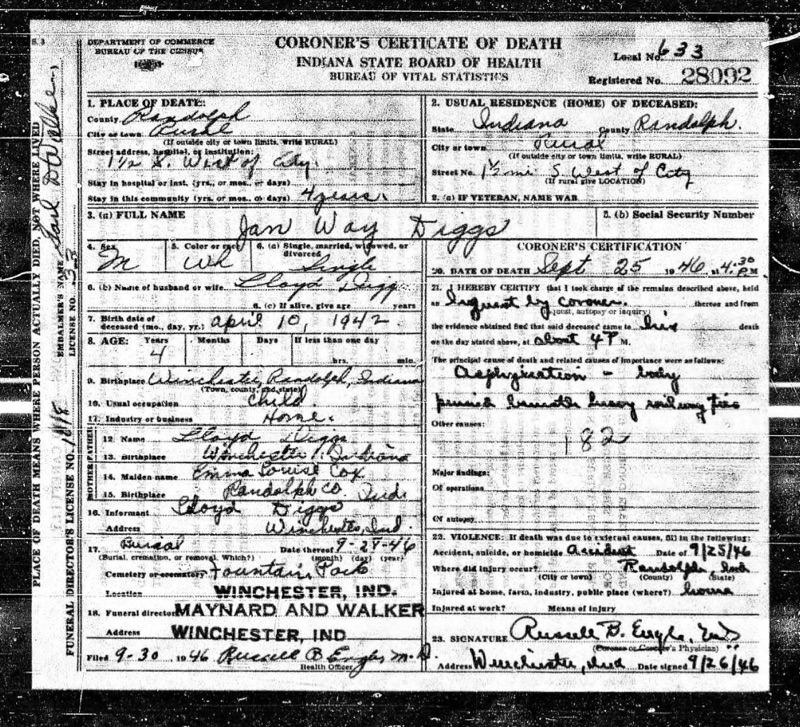
258. Randolph County, Ind. News: 4 Year Old Crushed By Ties.
Coroner's Report To The Clerk of The Randolph County Circuit Court, Winchester, Indiana. Cause: Death of Jan Way Diggs, September 25, 19...
-
 I found this in a box of 'stuff' at the museum. There is no date, but possibly Mr. Coffman wrote this in the 1980's? Does anyo...
 -
 On the first floor of a massive red brick building along U.S. 27 lives John Doty, a quiet, fragile man who, for all practical purpses...
 -
News-Gazette, March 1979. by William Jackson. The cabin which stands in Goodrich Park in Winchester, across from the Winchester Commu...